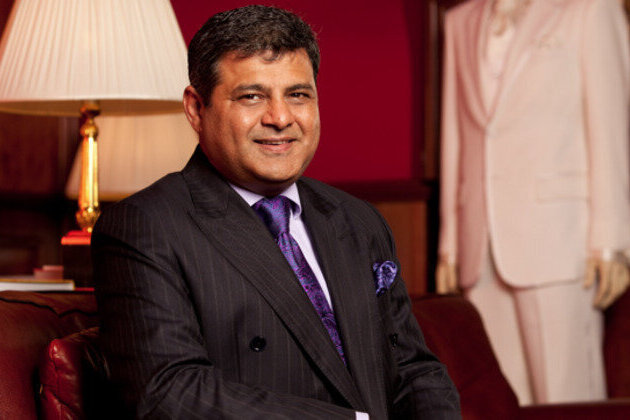
(Moscow Bureau) - Executive President of the Indian Business Alliance (IBA),Sammy Manoj Kotwani, discusses the landmark moment in deepening Russian-Indian collaboration. Kotwani explains the groundbreaking insights into President Vladimir Putin's working visit to India, the emerging opportunities and pathways for future cooperation, especially for the two-sided economic collaboration.Follow Sammy Manoj Kotwani's discussions here:
By Kester Kenn Klomegah
1.Interpretation of the latest development in Russian-Indian relations
From my viewpoint in Moscow, this visit has effectively opened a new operational chapter in what has always been described as a Special and Privileged Strategic Partnership. It did not just reaffirm political goodwill; it translated that goodwill into a structured economic roadmap through Programme 2030, a clear target to take bilateral trade to around USD 100 billion by 2030, and concrete sectoral priorities: energy, nuclear cooperation, critical minerals, manufacturing, connectivity, fertilizers, and labour mobility.
On the ground, the business community reads this summit as a strong signal that India and Russia are doubling down on strategic autonomy in a multipolar world order. Both sides are trying to de-risk their supply chains and payment systems from over-dependence on any single centre of power. This is visible in the focus on national currencies, alternative payment mechanisms, and efforts to stabilise RupeeRuble trade, alongside discussions on a Free Trade Agreement with the Eurasian Economic Union and the reinforcement of corridors like the INSTC and the ChennaiVladivostok route.
In short, my interpretation is that this summit has moved the relationship from politically excellent but structurally imbalanced towards a more diversified, long-term economic framework in which companies are expected to co-produce, co-innovate, and invest, not just trade opportunistically.
2.Significance of the visit for Indian business in Russia and for the Indian Business Alliance (IBA)
For Indian businesses operating in the Russian Federation, the visit has three immediate effects: confidence, clarity, and continuity. Confidence, because Indian entrepreneurs now see that despite external pressure, New Delhi and Moscow have explicitly committed to deepening economic engagementespecially in energy, fertilizers, defence co-production, nuclear, and critical mineralsrather than quietly scaling it back.
Clarity, because the summit outcomes spell out where the real opportunities lie:
Energy & Petrochemicals: Long-term crude and LNG supply, but also downstream opportunities in refining, petrochemicals, and logistics, where Indian EPC and service companies can participate.
Pharmaceuticals & Medical Devices: Russia's import substitution drive makes high-quality Indian generics, formulations, and even localized manufacturing extremely relevant.
IT, Digital & AI: There is a growing appetite in Russia for Indian IT services, cybersecurity, and digital solutions that are not dependent on Western tech stacks.
Fertilizers, Agro & Food Processing: New joint ventures in fertilizers and agriculture supply chains were explicitly flagged during and around the summit, which is important for both food security and farm incomes.
Continuity, because the Programme 2030 framework and the expected EAEU FTA give businesses a medium-term policy horizon. Tariff reductions, improved market access and predictable regulation are precisely what Indian SMEs and mid-sized companies need to justify long-term investments in Russia.
For the Indian Business Alliance (IBA), this inevitably means more work and more responsibility. We already see increased incoming requests from Indian firmsfrom large listed companies to first-time exportersasking very practical questions: Which Russian region should we enter? How do we navigate compliance under the sanctions environment? Which banks are still handling RupeeRuble or third-currency settlements? How can we structure joint ventures to align with Russias import substitution goals while protecting IP and governance standards?
IBA's role, therefore, becomes that of economic diplomacy in action: translating high-level summit language into actual B2B meetings, sectoral delegations, regional partnerships, and deal-making platforms such as the IndiaRussia Business Dialogue in Moscow. This visit will undoubtedly stimulate and intensify IBA's work as a bridge between the two ecosystems.
3.India's current economic presence in the Russian Federation
If we look beyond the headline trade figures, India's economic presence in Russia today is significant, but not yet commensurate with its potential. Bilateral trade has grown sharply since 2022, largely on the back of discounted Russian oil and coal, making India one of Russia's top energy customers. However, the structure is still heavily skewed: Russian exports to India dominate, while Indian exports and investments in Russia remain relatively modest and under-diversified.
On the ground in Moscow and across the regions, we see several strong Indian footholds:
Pharmaceuticals: Indian pharma is well-established, respected for its affordability and quality, and poised to deepen localization in line with the Russian import substitution policy.
Tea, Coffee, Spices & Food: Traditional segments with deep historical roots, now expanding into ready-to-eat, wellness, and ethnic food categories.
IT & Services: Still under-represented, but with growing interest as Russian entities look for non-Western software, integration, and outsourcing partners.
Diamonds, Textiles, Apparel, and Light Engineering: Present but fragmented, with enormous room to scale, especially if logistics and payment challenges are addressed.
Where India is still behind is in on-the-ground investment and manufacturing presence compared to countries like China. Russian policymakers today are clearly favouring investors who help them achieve technological sovereignty and local value addition. For serious Indian companies willing to commit capital, adapt to Russian standards, and accept the complexities of the current environment, this is a period of unusual opportunity. For purely transactional players looking for quick arbitrage, it is becoming progressively harder.
So I would characterise India's economic presence as: strategically important, quickly growing in value, but still under-leveraged in terms of depth, diversification, and localization.
4.Geopolitical pressure from Washington and future predictions
Pressure from Washingtonthrough sanctions, secondary sanctions risk, financial restrictions, and now even tariff measures linked to Indias energy purchases from Russiais undoubtedly a real and continuing challenge. It affects everything from shipping insurance and dollar transactions to technology transfers and the risk appetite of global banks. In practical terms, it can complicate even a simple IndiaRussia trade deal if it touches a sanctioned bank, vessel, or technology.
However, my own assessment, based on 35 years of living and working in Russia, is that this pressure will not fundamentally derail IndiaRussia friendship, but it will reshape how the relationship functions. India's foreign policy is anchored in strategic autonomy; it seeks strong ties with the United States and Europe, but not at the cost of abandoning a time-tested partner like Russia. Russia, for its part, sees India as a crucial Asian pole in an emerging multipolar world order and as a long-term market, technology partner, and political counterpart in forums like BRICS, SCO, and the G20.
Looking ahead, I see a few clear trends:
Normalization of alternative payment and logistics systems
We will see more institutionalised use of national currencies, alternative messaging systems, regional banks outside the direct sanctions line, and maybe even digital currencies for specific corridors. RupeeRuble trade mechanisms that are today seen as workarounds will gradually become part of the normal infrastructure of bilateral commerce.
Shift from pure trade to co-production and joint innovation
To reduce vulnerability to sanctions, both sides will push for manufacturing in India and Russia rather than simple exports: defence co-development, localized pharma and medical devices, high-tech and AI collaborations, and joint ventures in critical minerals and clean energy.
Greater role for regions and business associations
Regional governments in Russia (Far East, Arctic regions, industrial hubs) and Indian states will increasingly drive project-level cooperation, supported by platforms like IBA. This bottom-up economic diplomacy will make the relationship more resilient than if it relied only on central governments.
Managed balancing by India
India will continue to deepen technology and investment ties with the West while maintaining energy, defence and strategic cooperation with Russia. The challenge will be to manage U.S. and EU expectations without compromising its core national interests. My prediction is that India will stay firm on this course of balanced engagement, even if it means occasional friction with Washington.
In essence, external pressure may complicate the methods of Indo-Russian cooperation, but it is unlikely to overturn the foundations of trust, mutual interest, and long-term complementarity that have been built over decades.
David Andersson



 Share
Share
 Tweet
Tweet
 Share
Share
 Flip
Flip
 Email
Email