*Throughout the year, multiple conflicts persisted in the Middle East, overlapping and often taking unexpected turns.
*Middle Eastern countries are coordinating to advance political solutions to regional challenges while seeking greater unity and autonomy.
*China has offered global initiatives, mediation efforts, practical cooperation, and governance experience, injecting positive momentum into regional peace and revitalization.
CAIRO, Dec. 24 (Xinhua) -- In 2025, the world has witnessed a profoundly volatile yet increasingly transformative Middle East.
With U.S. military and political backing, Israel carried out strikes across multiple fronts, triggering conflicts at a level unseen in decades. This turbulence laid bare the region's entrenched instability and persistent security challenges.
Meanwhile, amid profound global changes, Middle Eastern nations are charting a new course -- pursuing common security, seeking independent development, and driving reform in global governance. Such aspirations reflect the awakening of the broader Global South.
Standing firmly with the Middle East in the pursuit of justice, peace and development, China has offered global initiatives, mediation efforts, practical cooperation, and governance experience, injecting positive momentum into regional peace and revitalization.
AN INTRACTABLE SECURITY DILEMMA
Throughout the year, multiple conflicts persisted in the Middle East, overlapping and often taking unexpected turns. Despite shifts in regional power dynamics, turmoil showed no sign of abating.
The latest Gaza war passed its two-year mark amid recurring cycles of war and truce. A ceasefire between Israel and Hamas was reached in October, but periodic Israeli strikes have continued, with more than 400 Palestinians killed so far since the truce, while disputes over Gaza's post-war governance remain unresolved.
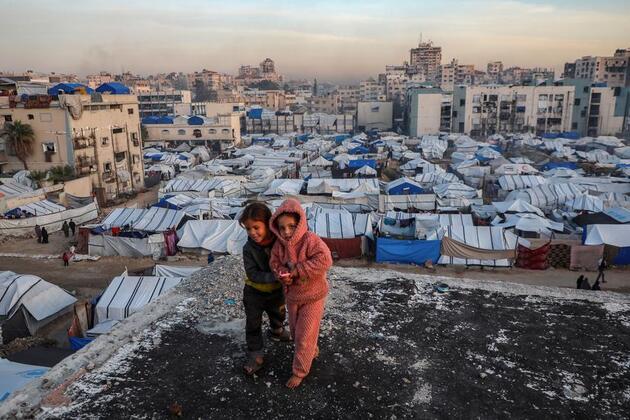
Today, Gaza lies in ruins. Local authorities report a death toll exceeding 70,000, with over 90 percent of buildings in the strip destroyed. Palestinians who survived the harrowing conflict now face shortages of supplies, skyrocketing prices, and the bitter cold of winter, as the humanitarian crisis remains dire.
Over the past year, the Gaza conflict's spillover effects continued to spread, with Israel striking targets in Lebanon, Syria and Yemen. The most significant rupture occurred in mid-June, when an Israeli surprise attack on Iran ignited a "12-day war." The United States directly entered the fray, bombing Iranian nuclear facilities -- a move that sharply escalated tensions and briefly threatened to trigger a full-scale regional conflagration.
In early September, Israel struck a Hamas delegation in Doha, Qatar, extending the conflict to Gulf Arab states for the first time in a norm-breaking development that shocked and alarmed countries across the region.
Meanwhile, internal conflicts have continued in several countries. The bloody civil war in Sudan shows no signs of abating, while Yemen and Libya remain fractured. In Syria, even a year after dramatic political shifts, the transition remains "a tightrope walk," beset by security threats and internal ethnic tensions.
The chaos in the Middle East stems from both complex historical grievances and the geopolitical maneuvering of outside powers. The reckless actions of certain countries have severely undermined an already fragile security situation.
For decision-makers and observers, 2025 offered hard lessons: military strikes cannot address root causes, force cannot bring genuine security, and zero-sum thinking cannot deliver lasting peace. Without justice, even signed peace agreements can result in only "cold peace," rather than genuine reconciliation and lasting stability.
Despite new shifts in the region's geopolitical landscape and power dynamics, the underlying security challenges and the structural tensions fueling conflict persist. A definitive solution to the Palestinian question within the two-state framework remains a distant and daunting goal. The Middle East will likely face a prolonged period of volatility, with low-intensity conflict becoming the new normal.
A CONCERTED PURSUIT OF CHANGE
As the Middle East struggles through cycles of conflict and suffering, regional leaders and thinkers are searching for a lasting cure.
"At the heart of the region's troubles are questions of governance," said Maha Yahya, director of the Beirut-based Malcolm H. Kerr Carnegie Middle East Center, who argues that without political solutions, durable peace remains a phantom.
Essam Shiha, head of the Egyptian Organization for Human Rights, said that the difficulty in halting the Gaza war highlights the inadequacy of the current international system and the degradation of international law into a "selective tool" used by certain major powers.
Against such a volatile backdrop, a clear trend has emerged: Middle Eastern countries are coordinating to advance political solutions to regional challenges while seeking greater unity and autonomy.
In January, after U.S. President Donald Trump proposed "taking over Gaza," Saudi Arabia, Egypt and other Arab nations quickly pushed back and launched urgent consultations. In early March, an emergency Arab summit in Cairo approved a comprehensive Arab plan for rebuilding the territory.
Since fighting reignited in March, Doha and Cairo have rolled out intensive mediation efforts, shuttling between Hamas, Washington and Israel. Such endeavors have shown that, when acting in unison, the region can wield a level of influence long assumed to lie solely in the hands of external powers.
Meanwhile, the international community -- especially Global South countries -- has not remained idle. As the death toll in Gaza soared and famine spread, global support for Palestine and condemnation of Israel grew markedly. Global South nations actively advocated for Palestine, emphasizing the importance of a two-state solution.
During the UN General Assembly in September, a high-level international conference on the peaceful resolution of the Palestinian question was held. France and several other Western nations announced recognition of Palestinian statehood, leaving Israel and the United States increasingly isolated on the international stage.
While this "wave of recognition" has not halted Israel's unilateral actions, it reflects the broader tide of global governance transformation. As Amr Hamzawy of the Carnegie Endowment for International Peace observes, it signals the Global South's growing demands to reshape global governance -- a call so powerful that Western capitals can no longer look away.
Like their peers across the Global South, Middle Eastern countries are exhibiting stronger determination to drive global governance reform and seek greater roles in international affairs. Their engagement in multilateral mechanisms such as BRICS and the Shanghai Cooperation Organization has grown steadily.
For example, over the past year, Saudi Arabia and Trkiye, acting as mediators, helped organize multiple rounds of talks among the United States, Russia and Ukraine, actively promoting efforts to resolve the Ukraine crisis.
Amid changes unseen in a century, a growing number of Middle Eastern nations are independently exploring new development paths. Led by Gulf states, the region is accelerating economic diversification, making major investments in artificial intelligence and renewable energy.
In late 2025, Trkiye and Iran announced plans to jointly build a railway connecting the two countries, while Saudi Arabia and Qatar agreed to construct a high-speed railway linking their capitals, both part of a broader push for regional connectivity.
A SOURCE OF INSPIRATION AND HOPE
While peace and stability remain the aspirations of Middle Eastern countries and a pressing concern for the international community, the four global initiatives and other major proposals proposed by China have injected stability and certainty into a turbulent world, contributing Chinese perspectives and solutions for peace and development.
In the view of Kawa Mahmoud, former general secretary of the Kurdistan Communist Party of Iraq, China's initiatives respond to the strong demands of developing nations for fairness and justice, offer sustainable solutions to current global challenges, and hold particular relevance for the Middle East.
The Palestinian question remains central to regional tensions. Through its active participation in addressing Middle Eastern issues through the UN Security Council and other multilateral platforms, China has demonstrated its principled stance on upholding justice and its constructive role, earning recognition and support across the region.
Meanwhile, development and revitalization are shared priorities for both Middle Eastern countries and the broader Global South. Despite prolonged instability, the region retains significant economic potential. The IMF reported in October that the Middle East demonstrated economic resilience in 2025, with its economic growth rate projected to reach 3.3 percent.
China is a reliable strategic partner for Middle Eastern countries and a sincere friend to Arab nations. Mutually beneficial cooperation between them continues to grow, empowering sustainable development in the region.
A November report by British think tank Asia House noted that in 2024, the Gulf Arab countries' trade with China surpassed their combined trade with the United States, Britain, and the eurozone, while cooperation expanded beyond traditional energy to renewable energy, high technology, construction, and other sectors.
In addition, as Osama Gohary, assistant to the Egyptian prime minister, and others have pointed out, China's recently outlined development priorities for 2026-2030 align closely with the development agendas of multiple Middle Eastern countries, creating new opportunities for win-win cooperation and shared growth.
The theory and practice of Chinese modernization, including China's successful governance experience, have also provided Middle Eastern nations with inspiration and hope for the future. Mohamed Hussein, first deputy head of Egypt's State Information Service, said that Chinese modernization presents a path distinct from Westernization, offering valuable insights for exploring modernization strategies compatible with Arab cultural traditions.
The coming year marks the 70th anniversary of diplomatic relations between China and Arab countries, with the second China-Arab States Summit to be held in China. This will set a new milestone in bilateral relations, injecting fresh momentum into building a higher-level China-Arab community with a shared future, and making new contributions to peace and development in the Middle East and beyond.
(Video reporter: Huang Zemin; Video editors: Liu Ruoshi and Liu Xiaorui)



 Share
Share
 Tweet
Tweet
 Share
Share
 Flip
Flip
 Email
Email