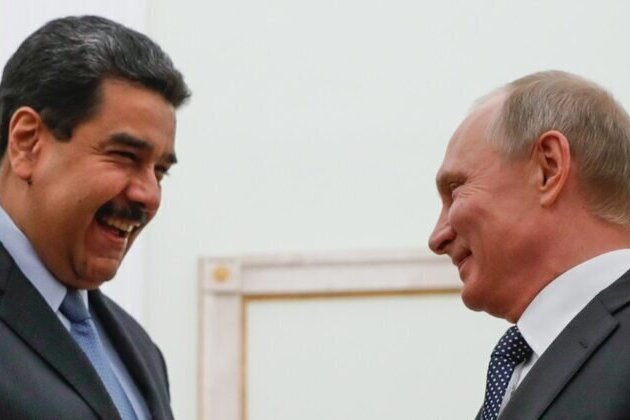
Over more than two decades, Russia has embedded itself in Venezuela's military, energy sector, and political elite, courting Hugo Chavez and his successor, Nicolas Maduro, both ardent critics of the United States, and establishing a firm foothold in the Western Hemisphere.
Throughout President Vladimir Putin's 26 years in power, Russia has cultivated personal relationships, institutional links, and commercial interests in the South American nation. Analysts say that despite the UScaptureof Maduro, these links are unlikely to disappear overnight.
"Dismantling them would be costly and complex," Berlin-based independent analyst Alexandra Sitenko told RFE/RL.
The ties extend to Venezuela's interim leadership. Delcy Rodriguez, who served as vice president under Maduro, has long maintained close relations with Moscow.
In 2024, Putin awarded Rodriguez a Russian state honor called the Order of Friendship, and Moscow has also publicly voiced support for her as interim leader.
"Delcy Rodriguez is someone the Russians know and can work with," Mark Galeotti, a Russia analyst and honorary professor at University College London's School of Slavonic and East European Studies, wrote in a January 7 blogpostfor the British outlet iNews.
SEE ALSO:
Venezuela Convulses And Russia Frets: What Does Moscow Stand To Lose If The Maduro Government Falls?
The question now is how much of its presence Russia can realistically preserve. Moscow's ability to exert influence in the near term is limited, analysts say, and pushing against the United States could be counterproductive.
'No Reason Not To Try'
As time passes since the abrupt US capture of Maduro in an overnight strike on January 3, the Kremlin seems to be taking stock of the situation. Ten days later, Putin had made no public comment.
"Moscow has no reason not to try to remain a player in Venezuela," Paul Goble, a senior fellow at the Jamestown Foundation, told RFE/RL. "But it is unlikely to assume a high-profile role anytime soon, as the US would likely respond in ways that would harm Russia more."
Russia's focus on its war in Ukraine may limit its ability and desire to assume such a role.
"It seems more likely that Russia will focus its efforts instead on trying to dissuade further USseizuresof sanctioned oil tankers like the Bella-1/Marinera, given the importance of the global ghost fleet to its economy and war machine," Henry Ziemer, an associate fellow with the Americas Program at the Center for Strategic and International Studies, told RFE/RL.
US naval forces boarded andseizedthe Bella 1, which had recently been renamed the Marinera and was flying a Russian flag, in the North Atlantic on January 7.
It was a blow to Russia's use of a "shadow fleet" of vessels to transport sanctioned energy products.
Russia's criticism of the move has been muted, but Ziemer said he would "expect more Russian military threats of retaliation if the US seizes additional tankers, including potentially nuclear posturing."
"If this succeeds in reducing US enforcement actions, it could indirectly ease pressure on the remaining Chavista structures in Venezuela," he said, referring to the legacy of Chavez, who died in 2013 and had chosen Maduro as his successor. "But I do not expect overt Russian efforts to influence domestic Venezuelan policy."
All About Oil?
Another key question is whether Russia can hold on to its oil interests in Venezuela, which has the world's largest proven oil reserves and where Moscow has invested billions of dollars in the sector over the past two decades.
"Russia may try to argue that these assets are legally protected Russian property," Vladimir Rouvinski, a professor of political studies at the University of Icesi in Cali, Colombia, told RFE/RL.
Moscow took a step in that direction on January 13: The state-run company Roszarubezhneftsaidthe oil assets it is developing in Venezuela belong to Russia and it intends to continue operating there.
US President Donald Trump, however, has signaled that Washington intends to control Venezuela's oil sales. On January 9, he said the United States would sell China and Russia "all the oil they need" as his administration moves to take control of Venezuelan oil exports.
"Rhetoric from the White Housesuggests that it will seek for US companies to have preferential access to opportunities in the oil sector, and would likely reject Russian claims to oil infrastructure," Ziemer told RFE/RL.
Soon after its incorporation in 2020, Roszarubezhneft acquired Venezuelan oil assets from Russian state giant Rosneft after the US imposed sanctions on two Rosneft subsidiaries for trading Venezuelan oil.
It holds the second-largest foreign claim to Venezuelan oil sector assets after China's Sinopec, which is entitled to about 2.8 billion barrels, according to data reported byBloomberg News.
Moscow's Military Legacy
Outside the hydrocarbons industry, Ziemer said, "I would not rule out the possibility that the United States would permit, for instance, Russian private companies to continue selling their products in Venezuela or Russian businesses to pursue deals in non-oil or defense-related sectors."
Russia has been Venezuela's main arms supplier for years, providing air-defense systems, aircraft, and small arms.
In October, as Washington deployed forces to the Caribbean while weighing military options tied to what it described as a counternarcotics campaign, MaduroclaimedVenezuela had some 5,000 Russian-made Igla-S anti-aircraft missiles deployed at "key air defense positions."
Around the same time, RFE/RL's Russian Service and other outletsreportedon possible deliveries of Russian air-defense components, including the Pantsir-S system.
Boots On The Ground?
However, Russia's ambassador to Venezuelasuggestedon Russian state TV on January 10 that Venezuela's Russian-supplied air defenses were ineffective during the US operation to capture Maduro, citing "serious problems" with communications between elements of the systems.
Citing unnamed US officials, The New York Timesreportedon January 12 that the S-300 and Buk M-2 air defense systems were not hooked up to radar when the US strike occurred, adding detail to the account from the ambassador, Sergei Melik-Bagdasarov.
One unresolved question is the fate of roughly 100 Russian military personnel sent to Venezuela in 2019, in what Moscow described as training and advisory missions, amid a US-backed challenge to Maduro's grip on power.
There has been no official confirmation of their withdrawal. Rouvinski told RFE/RL he has not heard of a Russian military presence in Venezuela "for a long time," adding, "If there were even 100 Russians there, the local Russian community would know," he said.
SEE ALSO:
Counting On Carte Blanche: What Maduro's Capture Could Mean For Russia
A possible explanation for Russia's relatively mild reaction to the US seizure of Maduro and the tanker is the Kremlin's longstanding desire for an understanding in which Russia would accept US dominance in the Western Hemisphere in exchange for Moscow's free rein in what it considers its own sphere of influence, particularly in Ukraine.
"Russia is pausing to see how this unfolds," Rouvinski said.



 Share
Share
 Tweet
Tweet
 Share
Share
 Flip
Flip
 Email
Email