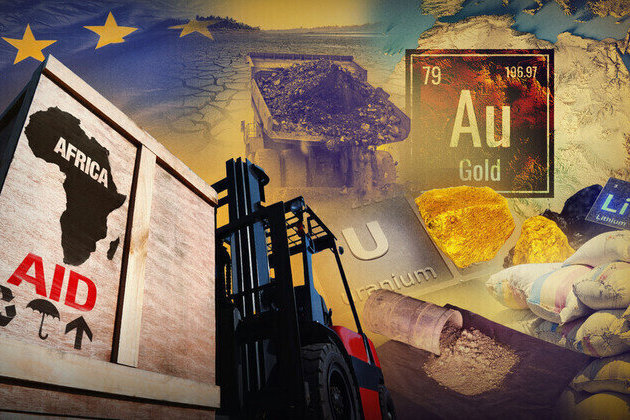
The debate over aid for Africa raises a vital concern: Is the true cost a loss of sovereignty?
Western engagement in Africa has for too long centered on humanitarian aid, portraying the continent as impoverished. However, beneath this veil of cooperation lie systemic issues that perpetuate dependency and obstruct true progress. History reminds us that 'generosity' often comes with hidden costs that stall the continent's development.
A new position of the European Commission that came to the light last May is that aid to so-called poor countries in sub-Saharan Africa and Middle East should be attached to the strategic interests of the European Union.
"These [partnership] packages will reinforce the link between external action and internal priorities, such as energy security, the supply of critical raw materials," European Commission President Ursula von der Leyen and Budget Commissioner Piotr Serafinstated.
European Commission President Ursula Von der Leyen
Nicol Campo/LightRocket via Getty Images
While this recalibration signals a pragmatic albeit controversial new step, history suggests that Western engagement with Africa, since its early encounters, has predominantly been entangled with material and strategic interests, including extracting raw materials and influencing socio-political structures.
The old story in new clothing
Africa has always attracted European powers due to its vast resources and youthful population, a reason for its colonial invasion and exploitation under the guise of humanitarianism, codenamed a "civilizing mission."
The striking resemblance between the civilizing mission during the colonial period and some aid schemes in the 21st century speaks to one thing: that aid comes with a veil that must be uncovered to reveal its true cost.
The situation in the Sahel serves as a poignant example. Recently, aid was withdrawn/suspended from Burkina, Mali and Niger despite these countries grappling with armed insurgents, many of which can be traced back to NATO's 2011 invasion of Libya. This was largely a result of their decision to channel their internal sovereign path to development.
Tuareg rebels patrolling near their camp in March 2006
Patrick ROBERT/Corbis via Getty Images
In Niger alone, EU budgetary assistance worth 500 million euros from 2021-2024 for education, governance and sustainable development, including about 75 million euros in military support, were allsuspended. While Niger benefitted from this development and humanitarian aid in previous years, the main goals of the aid included controlling the spread of global terrorism, as well as the upsurge of migrants seeking to enter Europe through Niger and to protect European mining interests.
Aid with strings
Concerning migration, following the EU-Africa Valletta summit in November 2015, the EUadoptedthe European Union Trust Fund for Africa (EUTF), focusing on what was considered irregular migration. Nigerien authorities were then enticed with funding from France, andpressuredpolitically to pass a restrictive law to tackle what was considered irregular migration, despite fierce resistance from the local population.
While Nigeriens themselves are not well-known for migrating, it was targeted at migrants that travel though Niger on their way to Europe, due to its strategic location. The resistance from the people, however, was primarily due to the fact that the country's economy heavily relies on migrants. Furthermore, the initiative did not include local actors in its adoption, while the local population experiences thebruntof its effect, including restricting the freedom of movement of Nigeriens within their country as well as within ECOWAS (the Economic Community of West African States).
The situation is worse when it comes to other social matters, such as regulating LGBT. Following the criminalization of LGBT in Uganda for instance, Norway and the Netherlands reportedlyfrozeabout $9 million in aid, with Denmark rescinding its aid to the Ugandan government, despite the country relying on it for 20% of its annual budget. Not even a healthcare loan from the World Bank was spared.
As Kwame Nkrumah, the first president of Ghana,argued,the arrival of aid brought with it conditions that restricted the political decision-makingof the newly independent governments. In this way, former imperial powers continued to maintain control over the governments and budgets of their former colonies.
President Kwame Nkrumah of Ghana addresses the General Assembly of the United Nations, New York, New York, September 23, 1960.
Underwood Archives/Getty Images
"Very unequal" partnership
Economically, Europe significantly benefits from Africa's mineral resources. Niger's uranium exports to the EU are a key example. Niger's uranium orecomprisesaround 25% of the supply used by European nuclear power plants. While most uranium produced in Niger goes to the EU, its main importer within the bloc is France, where around 70 percent of electricity isgeneratedfrom nuclear power.
This reliance grew after the last 230 mines in France were closed down in the early 2000s. With this act, the unspokencalculationwas evident: polluting Niger is cheaper than polluting France.
Orano, a French mining company engaged in uranium extraction in Niger, has long been accused of releasing atmospheric radon-222 gas, a substance linked to lung cancer, in its town of operation, Arlit. Findings from a study conducted in 2000revealedthat "the death rates due to respiratory infection in the [mining] town of Arlit in Niger is about 16.19%, twice that of the national average of 8.54%."
This is a satellite image of the Arlit Uranium Mine in Niger from February 13, 2013.
DigitalGlobe via Getty Images via Getty Images
Niger's former energy minister, Mahaman Laouan Gaya, in 2023describedthe partnership with France as "very unequal." He stressed that in 2010, Niger exported €3.5 billion ($3.8 billion) worth of uranium to France, but Niger only received €459 million.
This came at a time when The Spectacles, a Nigeria-based media outlet,allegedthat France had bought Niger's uranium at $0.80/kg, far below the market price at the time of around $200, while Orano continued to take a disproportionate share of uranium produce in Niger.
These actions compelled the military government of Niger to nationalize one of its uranium mines. "Faced with the irresponsible, illegal, and unfair behavior by Orano, a company owned by the French state, a state openly hostile toward Niger since July 26, 2023 ... the government of Niger has decided, in full sovereignty, to nationalize Somair," the authoritiesstated.
Weaponized narratives
Western NGOs and some humanitarian agencies have been the medium through which most humanitarian aid reaches the shores of Africa. It's not uncommon that they use media featuring African children taken in unknown villages, far beyond the sprawling African cities, to back stereotypes, and depict the continent as a region dominated by corruption, conflicts, human rights violations, hunger, poverty and a lack of social amenities.
These narratives are extensively trumpeted by some of the media companies, reinforcing the perception that Africa is dependent and dysfunctional,costingthe continent a staggering $4.2 billion in inflated interest payments annually. Investors and policymakers have begun to absorb these narratives; they label loans to the continent high-risk investments, and consequently charge higher interest rates than there would be if the continent was considered economically and politically stable, peaceful, credible and investor-friendly.
These portrayals can be used in perpetrating more deliberately targeted acts of sabotage. In 2024, for instance, David Hundeyin, a Nigerian investigative journalist, allegedly rejected a bribe offered by Dialogue Earth, a London-based NGO, to sabotage the Dangote oil refinery in Nigeria. The construction of the facility had been hailed as a majorbreakthroughfor Nigeria's oil industry; it ranks above Europe's largest refineries in terms of production and has significantly reduced the country's reliance on petroleum imports.
Oil installations at the Dangote refinery during the opening ceremony in Lagos, Nigeria, Monday, May 22, 2023.
AP Photo/Sunday Alamba
"Last week I received 800,000 Naira ($500) offer from an International NGO called Dialogue Earth (Formerly known China Dialogue Trust) to write an article essentially saying that Dangote Refinery is terrible for the environment because something something environmental concern, something something climate change, something something energy transition policy, something something COP28," hesharedon his official X page.
"Wolves in sheep's clothing"
One of the prominent players in this aid scheme was the United States Agency for International Development (USAID), an organization tasked with the obligation of disbursing capital and development assistance to so-called "developing countries" which was shut down by US President Donald Trump last year. The organization's reasoning had been rooted in theideaof John F. Kennedy, that American security was linked to the economic progress and stability of other countries.
The agencydisbursedalmost $44 billion in the 2023 fiscal year alone; about $12.1 billion wasallocatedto Sub-Saharan Africa.
However, despite the huge financial investment, many sub-Saharan African countries remain mired in economic struggles, some of them, such as Nigeria, Burkina Faso, Mali, Niger and Chad, primarily due to years of struggle against armed insurgents. Even though the United Nations haswarnedthat "This money (funding for terrorist groups) can come from legitimate sources, for example from business profits and charitable organizations, or from illegal activities including trafficking in weapons, drugs or people, or kidnapping," little is known about which charitable organizations fund terrorist activity in Africa, an act Scott Perry, a US congressman, believes USAID cannot be exonerated.
"Your (American tax payers') money $697 million plus shipment of cash, funds ISIS, Al-Qaeda, Boko Haram, ISIS Khorasan, terrorist training camp. That's what it is funding," hestated. President Trumpreferredto the organization as "governed by some lunatics" while tech billionaire Elon Muskstated"it's time for the criminal agency to die."
Dr. Arikana Chihombori-Quao, former African Union ambassador to the US, was even more blunt,calling the agency "wolves in sheep's clothing, which carry out nefarious activities in the African continent and destabilize governments through divide and conquer."
Dr. Arikana Chihombori-Quao, former African Union ambassador to the US.
Her statements emphasized the fact, that while a fraction of the funding went into delivering essential services, their acts were largely politically motivated, explaining its inability to deliver significant improvement in the living conditions of the people where it operated. The complexities surrounding the work of USAID reflect the dissatisfaction with what many consider a deviation of the organization from its enshrined purpose. It allegedly engaged in acts of deceptive benevolence, hence the need for it to be disbanded.
In a nutshell, the question of aid for Africa primarily concerns what the true cost of such aid is. African countries should re-assess and possibly disband some aid schemes. The process might be slow and painful, but as Thomas Sankara once said, "it's either Africans take champagne for few or safe drinking water for all."
Thomas Sankara's press conference, October 5, 1983.
Alain MINGAM/Gamma-Rapho via Getty Images
(RT.com)



 Share
Share
 Tweet
Tweet
 Share
Share
 Flip
Flip
 Email
Email