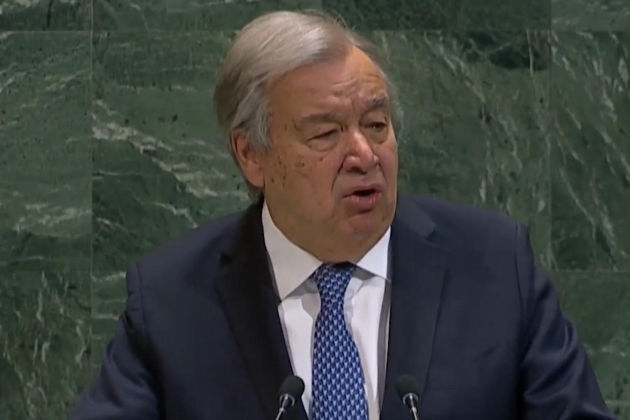
"The tariffs are, in the most literal sense, an own goal. Americans are footing the bill," said Germany's Kiel Institute for the World Economy.
WASHINGTON, Feb. 14 (Xinhua) -- When U.S. President Donald Trump unveiled his sweeping tariff package in 2025, he framed it as a cost to be borne by foreign exporters and governments.
Ten months later, the tariffs remain in force. By September 2025, the trade-weighted statutory rate had climbed to roughly 27 percent -- the highest level in nearly a century -- though the effective rate paid by importers was closer to 14 percent, according to a working paper by the U.S. National Bureau of Economic Research.
The central question is no longer what was promised, but who ultimately pays.
LEGAL LIABILITY FOR TARIFFS
Under U.S. law, tariffs are collected at the border by U.S. Customs and Border Protection. Legal liability rests with the importer of record -- typically a U.S.-based company bringing goods into the country. Foreign governments are not billed, and overseas exporters are not required to remit duties directly to Washington.
Legal responsibility, however, does not determine who bears the economic burden. Economists describe this as "tariff incidence" -- how the cost of a tariff is divided between foreign exporters and domestic importers. If exporters lower their prices to offset the duty, they absorb part of the burden; if export prices remain largely unchanged, the burden falls on the U.S. importers.
A study by the Federal Reserve Bank of New York found that nearly 90 percent of the tariffs' economic impact fell domestically. During the first eight months of 2025, the share reached 94 percent, before easing to 86 percent in November.
In an article published in the Chicago Booth Review, researchers analyzing U.S. official data estimated that 94 percent of the tariffs were passed along to U.S. importers in 2025. In the 10 sectors facing the largest tariff increases, pass-through rates reached as high as 114 percent.
Other independent analyses drew similar conclusions. The U.S. Congressional Budget Office (CBO) estimated that foreign exporters would absorb only about 5 percent of the cost, and Germany's Kiel Institute for the World Economy (IfW) in January calculated a tariff pass-through rate of 96 percent.
"In terms of who's paying for more of it, it's disproportionately, almost entirely so far, on the U.S. side," said Brent Neiman, a professor at the University of Chicago.
FROM IMPORTERS TO CONSUMERS
As the burden has largely remained within the United States, the next question is how it has been distributed domestically.
According to the CBO, in the near term, "U.S. businesses will absorb 30 percent of the import price increases by reducing their profit margins; the remaining 70 percent will be passed through to consumers by raising prices."
Corporate disclosures provide additional insights. An analysis by the Institute on Taxation and Economic Policy noted that companies across several industries in the United States have told investors they intend to pass tariff-related costs on to consumers through higher prices.
During a recent earnings call, agricultural equipment manufacturer John Deere said its tariff-related expenses are expected to double from 600 million U.S. dollars in 2025 to 1.2 billion dollars in 2026. Executives told investors they plan to adjust prices accordingly.
Similarly, ITT Inc., a manufacturer of transportation and industrial components, told investors at a December conference that price increases were implemented in response to tariffs, adding that "the customer is taking care of tariffs."
Newell Brands, a consumer products manufacturer, said in a December presentation that it increased prices "early and pretty aggressively" in response to tariff pressures.
According to the Budget Lab at Yale (TBL), the combined effect of the 2025 tariffs would raise overall prices by about 1.3 percent in the near term, translating into an average household income loss of roughly 1,800 dollars.
The burden is not evenly distributed: goods such as metals, leather and apparel could see much sharper adjustments, with initial price spikes of 28 to 40 percent before moderating to increases of 10 to 14 percent over time.
For U.S. consumers, the impact of higher import costs is felt most directly in everyday purchases.
Grocery prices have remained elevated even after the Trump administration exempted certain food and agricultural imports from its reciprocal tariff program in November. Beef is up 15 percent from a year earlier, while coffee costs have risen 18 percent, according to Axios.
Amid persistent price pressures, the Conference Board reported that U.S. consumer confidence fell in January to its lowest level in nearly 12 years.
The Wall Street Journal described the current environment as "a triple whammy" -- inflation, labor-market concerns and tariffs, noting that some interviewees doubted that the new tariffs would achieve much beyond raising prices.
"Everything is going up in price very quickly," Jeremy Tolbert, a 47-year-old web developer in Lawrence, Kansas, told CBS News.
GOVERNMENT GAINS FROM FAMILY LOSSES
When U.S. families face higher costs due to tariffs, the U.S. government gains more revenue.
According to the Financial Times, the tariffs have brought in 124 billion dollars for the federal government so far this fiscal year, more than triple the same period a year earlier. If Trump's 2025 tariffs remained in place, the TBL estimated that they would raise more than 2.5 trillion dollars over the next 10 years.
However, rather than transferring wealth from foreign countries to the United States, tariffs function much like a consumption tax -- shifting money from U.S. consumers to the U.S. Treasury, the IfW concluded. The TBL further highlighted the regressive nature of the tariffs, finding that the lowest income decile faces more than three times the short-run burden of the highest decile.
As for the economy, the CBO reported that inflation will be higher over the next three years than previously expected because of tariffs, and that tariffs will "continue to weigh on growth by raising the cost of imported goods, reducing investment from abroad, and lowering the efficiency of the U.S. economy."
U.S. supply chains will bear the costs as well. Companies relying on imported inputs face higher costs. The IfW warned that they must either absorb these costs by reducing profits and investment, pass them to customers by raising prices for downstream buyers, or scramble to find alternative sources, potentially incurring adjustment costs and delays.
"The tariffs are, in the most literal sense, an own goal. Americans are footing the bill," said the IfW.



 Share
Share
 Tweet
Tweet
 Share
Share
 Flip
Flip
 Email
Email