The global energy market is facing one of its most severe disruptions in decades with the effective closure of the Strait of Hormuz -- a vital artery for 20 percent of global maritime trade and a third of the world's liquefied natural gas (LNG) -- amid the US-Israeli war with Iran.
Coordinated Israeli air strikes on key Iranian gas facilities in South Pars and Asaluyeh, alongside Iran's retaliatory attacks on Saudi, UAE, and Qatari energy sites, have paralyzed tanker movements and the market response has been dramatic.
Brent crude surged to $116.38 per barrel on March 19, and European natural gas prices jumped sharply, reflecting the scarcity of physically deliverable energy. Skyrocketing gas prices have forced nitrogen fertilizer and urea plants to cut production just before the planting season, disrupting shipments and putting countries in Asia, Africa, and Latin America at risk of crop losses and famine.
SEE ALSO:
Bypassing The Kremlin: Armenia And Azerbaijan Expand Trade, Testing Russia's Grip
In light of this unprecedented market uncertainty, the strategic importance of Kazakhstan and Turkmenistan's energy reserves has never been greater.
Despite being sandwiched between the US-Israeli war with Iran to the south, the Russia-Ukraine conflict to the north, and the fallout from Pakistani air strikes in Afghanistan to the southeast, both countries possess substantial reserves that, if mobilized, could alleviate some of the pressure on global markets.
Turkmen Gas: A Rapid, Land-Based Relief Option
Turkmenistan holds around 19.5 trillion cubic meters of proven natural gas reserves, primarily in the Galkynysh field, making it the world's fourth-largest holder.
Most exports flow to China via the Central AsiaChina pipeline (3233 BCM per year). Smaller volumes go to the UAE and Oman via the Dolphin system, and limited amounts have recently reached Turkey through Iran under exchange agreements.
The war involving Iran has halted most regional exports outside China, leaving Turkmenistan's gas largely locked into existing pipelines. In an interview with RFE/RL, John Roberts, a nonresident senior fellow at the Atlantic Council's Global Energy Center, explains that Turkmenistan's gas offers a relatively rapid supply infusion in the current crisis.
SEE ALSO:
China Urges De-Escalation As Hormuz Crisis Deepens
"Roughly a fifth of the world's traded LNG comes from Qatar. That is now shut in. You can't produce the gas when you haven't got any export route for it," he said. "And there are no pipelines that go from Qatar in any substantial manner to major international destinations."
A local distribution system, called the Dolphin, serves the United Arab Emirates and Oman. But it's reach is limited, Roberts added, saying that an alternative supply is needed.
While "normally getting alternative supplies takes years to develop," Roberts said, one solution is to look to Turkmenistan.
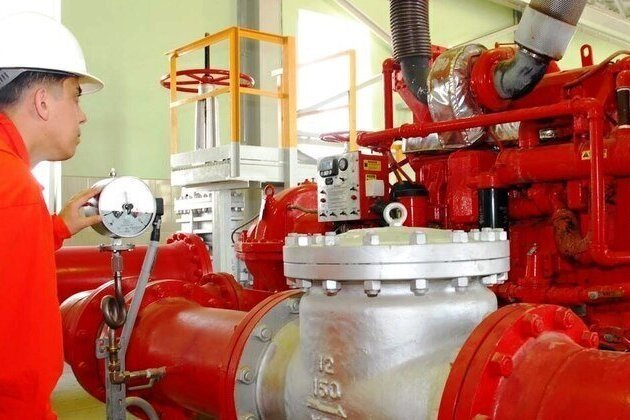
"Very quickly, that gas could cross the Caspian and enter into a ready-made export system, which is the Southern Gas Corridor, which was developed for Azerbaijan's Shah Deniz gas field," he explained.
"You could do it very quickly, which is the point here, by connecting the offshore terminals that produce gas at Mary-Magdanly, which is operated by Petronas, and nearby fields in Azerbaijan, such as the Azeri-Chirag-Gunashli (ACG) oil field operated by BP, or the Absheron gas field operated by TotalEnergies. Those would only require, in the first case, a 78-kilometer pipeline, in the second one of just over 100 kilometers."
SEE ALSO:
Iran's Chokehold On Hormuz And The Limits Of Military Force
Roberts said these are "local, simple solutions that would maximize existing infrastructure," adding that Azerbaijan's state oil and gas company, SOCAR, "told me about three years ago that they could do this within about four or five months."
It could all be done "quickly and cleanly," Roberts said.
Kazakh Oil: Infrastructure Constraints And Long-Term Prospects
While Turkmenistan offers a rapid, land-based option, Kazakhstan's oil sector faces longer-term structural barriers that limit immediate relief.
In an interview with RFE/RL's Azattyk Azia, Joseph Epstein, director of the Turan Center for Post-Soviet Studies, emphasized the structural and geopolitical limitations of Kazakhstan's oil sector.
"The crisis clearly shows that Central Asia's energy infrastructure was built for a geopolitical reality that no longer exists," he said. "Each major export route passes through a country involved in the war or under serious pressure -- Russia, Iran, or regions where they can influence maritime routes. This is a systemic risk, not something solved by a single pipeline."
"This crisis is a strategic turning point, but whether Central Asia can benefit from it depends entirely on infrastructure investment decisions made in the next two to three years."
Kazakhstan's oil illustrates the practical limits of turning resource endowment into immediate market relief.
SEE ALSO:
Fears Of Iranian Refugee Influx Grow In Central Asia As War Intensifies
Kazakhstan has roughly 30 billion barrels of proven oil reserves, producing about 1.4 million barrels per day. Roughly 80 percent of exports rely on the Caspian Pipeline Consortium to Novorossiysk.
Both Epstein and Roberts agree that rerouting Kazakh oil away from corridors controlled by Russia or Iran would take years. Much of the country's export flows rely on the Caspian Pipeline Consortium to the Black Sea terminal at Novorossiysk, Russia, a corridor repeatedly targeted by Ukrainian drone attacks since late 2025.
There's also a logistical barrier to rapid diversification.
"You can't get the oil to Baku from Kazakhstan easily, because you need a new generation of tankers," said Roberts. "The tanker traffic across the Caspian is pretty full as it is. Some Kazakh oil already goes out through that system. So does Turkmen oil going out to the international markets. But you would need a new generation of tankers. There is capacity in the Caspian to build tankers. But again, that's a sort of two- or three-year project; not something that can be done overnight."
SEE ALSO:
Iran War Sends Economic Ripples Through Central Asia, Turkmenistan Most Exposed
Against this backdrop of limited infrastructure and constrained export routes, attention is increasingly turning to the political dimension of energy cooperation, particularly Turkmenistan's growing engagement with the European Union.
Turkmen President Serdar Berdymukhammedov is preparing for an official visit to Brussels as the European Parliament moves closer to considering the ratification of a long-stalled partnership agreement with the European Union. Although a firm date for the visit has not yet been agreed, energy cooperation is expected to be a core focus of the agenda alongside wider political and economic issues.
The visit represents "a major development," according to Roberts. "The question is, can the European Commission and the Turkmen authorities come to an understanding that they both need to make major changes as to how they approach gas project development?"
In parallel with the president's Brussels visit, a Turkmenistan-EU forum is scheduled on March 26 in Ashgabat, jointly organized by the EU, Turkmenistan, and the International Trade Center, bringing together policymakers and business leaders to strengthen cooperation in energy, transport, and sustainable growth.
Central Asia Emerges As Strategic Energy Player Amid Oil Crisis
Share
Share
Copy link
Facebook
X (Twitter)
LinkedIn
Email
Share
Share
Copy link
Facebook
X (Twitter)
LinkedIn
Email
Print



 Share
Share
 Tweet
Tweet
 Share
Share
 Flip
Flip
 Email
Email