* Regional experts believe that while mounting regional and global pressure against the war could pave the way for a fragile, short-term ceasefire, a true end to the fighting remains a long way off, and the conflict risks dragging on with no real political settlement in sight.
* Pointing to what they see as the United States and Israel's disregard for international law in their heavy-handed strikes on Iran, analysts warn that the war is ratcheting up regional tensions and eroding the world order.
CAIRO, March 28 (Xinhua) -- As the U.S.-Israeli conflict with Iran approaches its one-month mark, the biggest flare-up in the Middle East in decades has caused widespread devastation across the region and severe shockwaves around the globe.
Despite reports of possible talks between Washington and Tehran to halt hostilities, no substantive progress toward peace has materialized, as continued strikes and a military buildup further diminish hopes for a swift de-escalation.
HEAVY TOLL
The war erupted on Feb. 28 with U.S.-Israeli airstrikes on Tehran and several other Iranian cities. Since then, the attacks have continued, targeting key Iranian military command centers, missile installations, energy infrastructures and nuclear facilities.
In response, Iran has launched over 80 waves of missile and drone strikes against Israel and U.S. military facilities across the Middle East, including those in Kuwait, Bahrain, Qatar, Jordan, Saudi Arabia and the United Arab Emirates.
The conflict has resulted in heavy casualties, with Iranian deaths estimated at over 1,900 and more than 24,800 injured, including the confirmed deaths of then Supreme Leader Ali Khamenei, top security official Ali Larijani, and Intelligence Minister Esmaeil Khatib. Israeli and U.S. forces have also suffered losses, with at least 19 Israeli and 13 U.S. military fatalities reported.
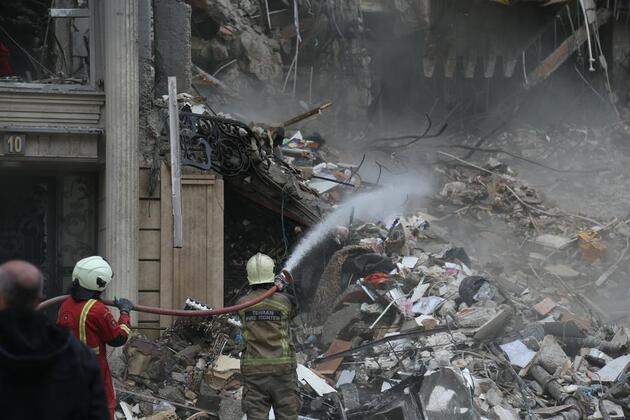
Meanwhile, several other countries have been hit by projectiles, suffering casualties. The Gulf's status as a bastion of peace and prosperity is in doubt. Critical energy infrastructure across the region has been attacked, with residents fleeing to safe havens in Southeast Asia and Europe and the lives of millions upended.
In the Levant, Hezbollah fired rockets into Israel on March 2 in a show of support for Iran, prompting Israeli airstrikes and a ground incursion into Lebanon that has reportedly killed 1,116 people and displaced over a million.
In a major escalation, Iran has effectively blockaded the Strait of Hormuz, allowing only ships it considers non-hostile to pass. This maritime squeeze, along with damage to regional energy facilities, has pushed oil prices higher, keeping Brent Crude above 100 U.S. dollars a barrel and up more than 50 percent since the war began.
According to a recent World Trade Organization report, sustained high energy prices could reduce projected global GDP growth in 2026 by 0.3 percentage points.
NO CLEAR EXIT
Israel's Channel 12 reported Tuesday that Washington has delivered to Iran a 15-point plan for a month-long ceasefire deal. Tehran, however, considers it too "excessive and disconnected from realities," Iran's state-run Press TV reported Wednesday.
Israeli Defense Minister Israel Katz announced Friday that Israeli strikes on Iran "will intensify and expand to additional targets."
Regional experts believe that while mounting regional and global pressure against the war could pave the way for a fragile, short-term ceasefire, a true end to the fighting remains a long way off, and the conflict risks dragging on with no real political settlement in sight.
"The most likely short-term scenario is a limited ceasefire driven by international pressure and repositioning," said Naji Ajeeb, a Sudanese conflict researcher. "Such a pause would be a tactical truce, allowing both sides to assess gains and prepare for further confrontation rather than achieving a comprehensive settlement."
Kamel Mansari, editor-in-chief of Le Jeune Independant, a French-language daily newspaper in Algeria, argues that the conflict could easily escalate into a prolonged war of attrition.
"A cessation of hostilities would require each side to claim a symbolic 'victory,' which is not currently the case," Mansari said. "If the United States and Israel do not cease their attacks against Iran, the conflict could escalate into a protracted asymmetric war."
In that case, regional players are likely to rely on indirect tools, including proxy attacks, limited strikes and cyber warfare, said Brigadier Pilot Adel Abdelkafi, security advisor to the Libyan High Council of State.
So far, Israel has shown the least interest in ending the war, with officials repeatedly opposing any potential ceasefire and signaling plans to escalate military operations.
Israeli political analyst Jonathan Lis observes that U.S. President Donald Trump's push for a swift deal with Iran is heightening Israeli concerns over potential U.S. compromises.
Israeli officials fear that the United States could show flexibility on critical issues, including Iran's stockpile of highly enriched uranium, restrictions on its nuclear program, and limitations on its ballistic missile capabilities, Lis said.
TEST FOR GLOBAL ORDER
Pointing to what they see as the United States and Israel's disregard for international law in their heavy-handed strikes on Iran, analysts warn that the war is ratcheting up regional tensions and eroding the world order.
Batu Coskun, an Ankara-based independent political analyst, cautions that the war risks intensifying regional polarization into long-term bloc politics. "Even if active fighting subsides, unresolved grievances and shifting alliances are likely to sow the seeds for future conflicts," Coskun said.
"Selective adherence to international norms undermines institutional credibility and may encourage similar behavior elsewhere," he said.
Mostafa Amin, an Egyptian researcher on Arab and international affairs, said the war is causing a crisis in the international system as unilateral actions undermine the UN-based global order.
"The broader international system faces a profound crisis as the United States increasingly sidelines the UN-based post-World War II global governance framework to facilitate its regional objectives," Amin said. "This encourages a transition toward a multipolar disorder where the pursuit of narrow, short-sighted interests dominates over international law."
As the war rages on, there may be a glimmer of hope.
"Calls for peace, particularly from countries like China, are significant in de-escalating tensions and encouraging dialogue among the parties involved," said Ayman Yousef, a professor of political science at the Arab American University in the West Bank.
But achieving lasting peace will require more countries to join a collective effort to uphold an international order rooted in multilateralism and coexistence, Yousef noted.
"Ultimately, achieving stability requires a collective international approach that prioritizes dialogue, respects international frameworks, and works toward long-term political solutions rather than short-term military gains," Yousef said.
(Video reporters: Shadati, Chen Xiao, Dong Xiuzhu, Yang Yiran, Zhang Yanfang, Feng Guorui, Huang Zemin, Shen Feng, Duan Minfu, He Yiping, Luo Chen, and Xu Haofu; Video editors: Hong Ling, Li Qin, Liu Xiaorui, and Zheng Qingbin)



 Share
Share
 Tweet
Tweet
 Share
Share
 Flip
Flip
 Email
Email