What began as a geopolitical flashpoint has evolved into a systemic economic shock, reverberating through energy markets, industrial supply chains and critical maritime routes.
BEIJING, March 31 (Xinhua) -- With U.S.-Israel joint military strikes on Iran entering the fifth week with no clear path to resolution, the economic aftershocks are spreading far beyond the Middle East.
What began as a geopolitical flashpoint has evolved into a systemic economic shock, reverberating through energy markets, industrial supply chains and critical maritime routes.
As the conflict drags on, its spillover effects are increasingly testing the resilience of the fragile global economic recovery.
GLOBAL OIL SHOCK
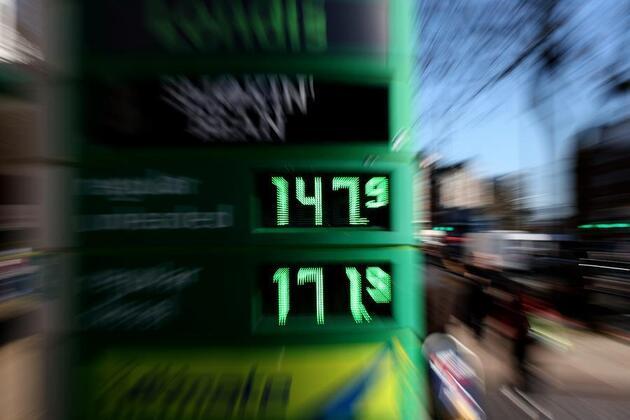
As part of its response to U.S. and Israeli operations, Iran has restricted navigation through the Strait of Hormuz, targeting ships associated with the United States and Israel. The blockade of this vital global energy route has driven up oil and gas prices worldwide.
On Monday, U.S. West Texas Intermediate crude for May delivery settled above 100 U.S. dollars for the first time since July 2022. Meanwhile, global benchmark Brent crude settled at 112.78 dollars a barrel, and is on track for a record monthly gain of over 50 percent in March.
U.S. President Donald Trump warned Monday on Truth Social that if a deal to end the war isn't reached "shortly" and the Strait of Hormuz is not immediately reopened, the United States would blow up and completely obliterate all of Iran's electric generating plants, oil wells and Kharg Island.
Later, The Wall Street Journal cited Trump administration officials as saying that Trump has told aides that he's willing to end the U.S.-Israeli war with Iran even if the Strait of Hormuz remains largely closed.
"A scenario in which the strait remains closed for an additional month would be consistent with oil prices rising towards 150 dollars a barrel and constraints on industrial consumers of energy supply," Bruce Kasman, global head of economics at JP Morgan, was quoted as saying by British newspaper The Times.
Describing the situation as "very severe," International Energy Agency (IEA) executive director Fatih Birol said that he is in talks with member countries on releasing more stockpiled oil in response to the supply crisis triggered by the conflict.
"A stock release will help to comfort the markets, but this is not the solution. It will only help to reduce the pain in the economy," Birol said last week in Australia.
Tensions in the Middle East also rattled global equity markets. Since the fighting began, major U.S. indices have dropped by more than 7 percent, while the pan-European STOXX 600 index has slid over 8 percent. Asian markets have also posted broad-based losses.
According to a recent WTO report, sustained high energy prices could reduce the 2026 global GDP forecast by 0.3 percentage points and lower trade growth by 0.5 percentage points.
"Sustained increases in energy prices could increase risks for global trade, with potential spillovers for food security and cost pressures on consumers and businesses," WTO Director-General Ngozi Okonjo-Iweala said.
In the United States, consumer sentiment has weakened noticeably, with the University of Michigan Consumer Sentiment Index dropping to a three-month low of 53.3, as war stokes inflation worries and clouds over the economic outlook.
In Europe, which relies heavily on energy imports and is already dealing with the fallout from the Ukraine crisis, the shock is even more acute for both industries and households.
Daan Struyven, co-Head of Global Commodities Research at Goldman Sachs, estimated that around 60 percent of European power prices are linked to natural gas, increasing the region's exposure to energy shocks.
The Organisation for Economic Co-operation and Development has cut its eurozone growth forecast for this year to 0.8 percent and raised its inflation outlook to 2.6 percent.
RIPPLE EFFECTS ACROSS INDUSTRIES
Beyond oil, the war in Iran is severely disrupting global commodity markets, particularly in energy-intensive and supply-chain-sensitive sectors.
The normally bustling Strait of Hormuz is not only a regular channel for crude oil but also a global agricultural artery for food and fertilizers.
According to data from the International Fertilizer Association, Gulf nations account for approximately one-third of the global exports of urea and nitrogen-based fertilizers.
Farmers worldwide are feeling the strain. As fertilizer becomes less affordable, crop yields could decline, driving food prices higher. The impact is likely to ripple through food supply chains, affecting everything from meat prices to processed goods, and ultimately posing risks to global food security.
According to a note released last Monday by Alpine Macro, a global investment research firm, urea and ammonia prices had surged by around 50 percent and 20 percent, respectively, since the war began, CNBC reported.
Turkish economist Murat Tufan describes the situation as a "vicious cycle" that extends beyond the reach of traditional monetary policy.
He noted that this is a supply-side crisis, which leaves central banks with limited options. "You cannot curb rising food costs through interest rate hikes alone when the primary drivers are external shocks to fuel and fertilizer."
Pressure is mounting on other key commodities as well. Helium, a critical industrial gas used in semiconductor manufacturing and medical equipment, faces potential shortages due to disruptions among major producers, including Qatar.
Aluminum, a key industrial metal used in automotive manufacturing, construction and packaging, has seen prices climb as production cuts in the Gulf region, logistical constraints and Iranian attacks on two regional producers over the weekend tightened supply.
Benchmark three-month aluminium on the London Metal Exchange briefly touched 3,492 dollars per metric ton during Monday's trading, near a four-year peak of 3,546.50 dollars, Reuters said.
Moreover, rising petrochemical costs are lifting prices for plastics, affecting a wide range of industries from textiles to consumer packaging.
LOGISTICS UNDER STRAIN
As the war drags on, Iran has been leveraging its grip on the Strait of Hormuz, reducing ship traffic through one of the world's most vital waterways to historical lows.
As of March 29, some 150 vessels had passed through the narrow chokepoint between the Persian Gulf and the Gulf of Oman since the war started, according to Kpler, a data analytics platform. Typically, some 120 ships cross it each day.
According to an estimate by S&P Global Market Intelligence, nearly 3,000 vessels are waiting nearby.
"A single 15,000 TEU (twenty-foot equivalent unit) vessel delayed for 10 days eliminates 150,000 TEU-days of productivity. Multiplied across the fleet, the impact is profound," it said in a recent analysis.
Rerouting is an option, but not necessarily preferable. West Coast Shipping, an international shipping services provider, said diverting Asia-Europe routes around Africa typically adds over 3,500 nautical miles (6,482 km), roughly 10-14 days, to each voyage.
It noted that when carriers halted Suez transits in 2022, voyages rerouted around the Cape of Good Hope increased transit times by about 20 percent, causing major disruption to global logistics chains.
The war has also disrupted key air transit hubs, rising fuel costs, tightening flight restrictions and forcing companies to reroute flights or take detours overland into the Gulf.
Major airports in Dubai, Abu Dhabi and Doha -- critical cargo hubs linking Europe with Asia and Africa -- have been knocked out of operation by Iranian strikes in response to U.S. and Israeli attacks, creating acute logistical headaches for Western drugmakers handling cancer drugs and other temperature-sensitive treatments.
One pharmaceutical executive told Reuters on condition of anonymity that alternative "cold-chain corridors" could not be set up overnight and were not always available.
Stocks of temperature-sensitive medicines usually last just three months, said Prashant Yadav, senior fellow for global health at the Council on Foreign Relations, warning that delivery delays could worsen outcomes for cancer patients.
Some customers have already flagged problems, Yadav added, noting that supplies could run out within a few weeks if conditions do not improve.
The bottlenecks caused by the near-standstill of the strait could run deeper than initially expected. David Weeks, director of supply chain risk management at ratings agency Moody's, cautioned that the problem is not always a shortage of medicine itself: "In some cases, it's the little stopper on the vial where the dosage is extracted."
(Video reporters: Yang Yating, Zhang Huan, Yuan Hengrui, Che Yunlong, Wu Yao, Safar Rajabov, Wang Jialin, Basel and Heba; Video editors: Liu Ruoshi, Zhu Cong, Liu Xiaorui and Zhang Yucheng)



 Share
Share
 Tweet
Tweet
 Share
Share
 Flip
Flip
 Email
Email