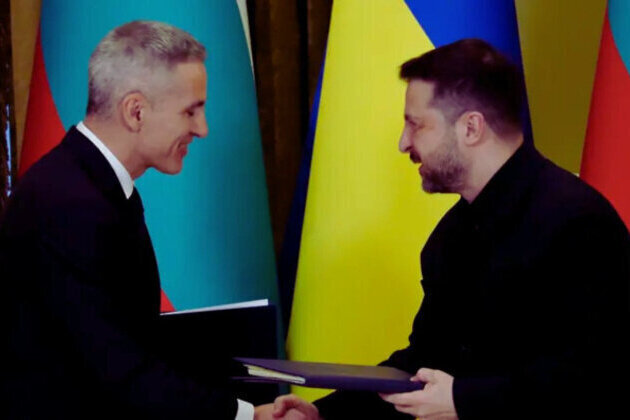
The political noise around the agreement signed by Acting Prime Minister Andrey Gyurov and President Volodymyr Zelensky on March 30 in Kyiv has largely drowned out what the document actually says. The caretaker government has since published the , and the picture it paints is considerably less dramatic than either its defenders or its critics have suggested.
The first thing worth establishing is what the agreement legally is, and what it is not. The final provisions of the document explicitly state that it falls outside the scope of the Vienna Convention on the Law of Treaties. In plain terms, this is not a binding international treaty. It carries no legally enforceable commitments, contains no financial obligations, and its implementation depends entirely on current Bulgarian legislation and future decisions by parliament. Former Prime Minister from the political coalition "We Continue the Change-Democratic Bulgaria" (WCC-DB), Nikolai Denkov, reviewing the text carefully, described it accurately as a framework of intentions rather than a set of concrete commitments. President Yotova reached much the same conclusion, though with considerably less generosity.
So what does it actually cover?
The largest and most substantive section deals with security and defense cooperation. Bulgaria commits to continuing and, where possible, expanding military assistance to Ukraine, including equipment and ammunition, within the limits of what parliament has already approved. The two countries agree to develop joint training programs covering drone operations, counter-drone systems, electronic warfare, special operations, and naval cooperation in the Black Sea. Bulgaria will provide individual and collective training to Ukrainian naval forces in areas including counter-mine operations and explosive ordnance disposal, with Ukrainian officers able to serve aboard Bulgarian naval vessels. Perhaps most practically, the agreement explicitly recognizes that Ukraine has accumulated battlefield experience and expertise that Bulgaria can learn from, and commits both sides to technology transfer and joint testing of systems developed during the war. This is the part Denkov flagged as genuinely valuable: Ukraine is arguably running the most advanced drone and electronic warfare operations in the world right now, and access to that knowledge has real worth for an aging Bulgarian military.
The defense industry section commits both countries to identifying opportunities for joint production of weapons and ammunition, and to working toward integrating Ukraine's defense industry into European defense frameworks, including the European Defense Technological and Industrial Base. Bulgaria also agrees to support Ukraine's efforts to clear the Black Sea of mines, which has direct relevance to Bulgarian commercial shipping once the war ends.
On the political side, the agreement reaffirms Bulgaria's support for Ukraine's path toward EU and NATO membership, commits Bulgaria to keeping frozen Russian sovereign assets under its jurisdiction until Russia compensates Ukraine for damages, and pledges continued cooperation on sanctions enforcement and accountability for war crimes. None of this represents a departure from existing Bulgarian policy or EU obligations.
The energy section is more specific and more interesting than it tends to get credit for. The two countries commit to developing the Vertical Gas Corridor as a strategic route for non-Russian natural gas, discuss the potential sale of equipment from the mothballed Belene nuclear project to Ukraine, and explore cooperation on electricity supply and transmission capacity. Given that Bulgaria spent years trapped in energy dependence on Russia and only recently began moving away from it, this section has practical long-term value for Sofia as much as for Kyiv.
There is also a section on humanitarian cooperation covering Bulgarian support for Ukrainian refugees, development assistance, and demining efforts, most of which reflects things Bulgaria was already doing.
On the education front, despite the controversy that erupted following the , the agreement itself contains nothing about introducing Ukrainian language teaching in Bulgarian schools. What it does include is a Ukrainian commitment to ensure Bulgarian-language instruction in schools serving the Bulgarian minority in Ukraine, and a reference to protecting the rights of the Bulgarian diaspora there. The broader language and curriculum discussions that caused the social media storm were not in this document.
The agreement runs for ten years from the date of signing, but includes a six-month termination clause allowing either side to exit with written notice. If Ukraine joins NATO before the ten years are up, the parties agree to adapt the arrangement accordingly.
Stripped of the political theatre, what was signed in Kyiv is a long-term statement of intent between two neighboring countries with shared interests in Black Sea security, energy independence from Russia, and Ukrainian reconstruction. Whether a caretaker government was the right vehicle for signing it remains a legitimate debate. What the document itself actually says is considerably more measured than the reaction to it suggested.
The political fallout
Gyurov defended the move, describing the agreement as a political signal of support for Ukraine and part of a broader effort to strengthen Bulgaria's defense capacity.
Despite these provisions, opposition parties reacted sharply. An attempt by ?Revival? to push through a parliamentary decision to terminate the agreement failed after an extraordinary session collapsed due to a lack of quorum. Fewer than the required 121 MPs registered during repeated checks, forcing the suspension of proceedings and preventing any vote on the proposal. The same session was also expected to hear ministers on fuel price measures, but this did not take place.
The agreement has also drawn criticism from President Iliana Yotova, former president Rumen Radev and other political actors. Supporters, however, argue that the document is largely declarative. Former prime minister Nikolai Denkov described it as a framework of intentions without specific or financial commitments. He noted that some elements could benefit Bulgaria, including cooperation on transport infrastructure, access to Ukrainian military expertise, joint efforts to clear mines in the Black Sea, and participation in Ukraine's future reconstruction.
Denkov stressed that strengthening defense capabilities and keeping the war at a distance from Bulgaria remain key national priorities. He also pointed out that the agreement leaves room for future development depending on political consensus, underlining that its implementation ultimately depends on decisions by a fully empowered parliament.
Further reading:



 Share
Share
 Tweet
Tweet
 Share
Share
 Flip
Flip
 Email
Email