ANI
02 May 2026, 16:39 GMT+10
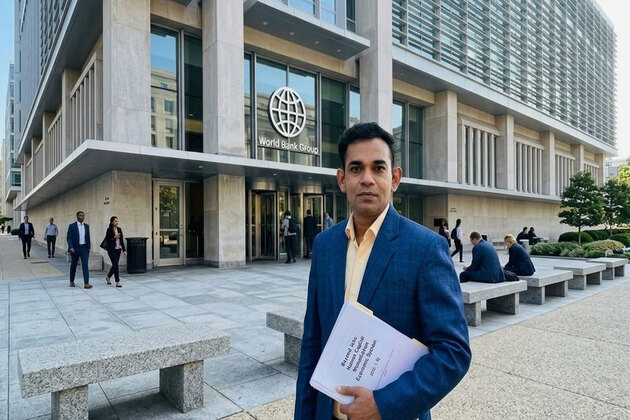
New Delhi [India], May 2 (ANI): Amid growing global concerns over a widening employment gap, a new economic framework has been proposed to address what experts warn could become one of the most pressing challenges of the coming decades.
Deepak Sharma, founder of the Human Capital Monetisation Economic System (HRMES), has written an appeal to Ajay Banga, President of the World Bank Group, calling for urgent structural reforms to tackle a projected global shortfall of 800 million jobs.
Citing global estimates, the World Bank Chief in his last report had stated that approximately 1.2 billion young people are expected to enter the workforce over the next 10 to 15 years, while current systems (Capitalism and Socialism) are projected to generate only about 400 million jobs. This imbalance, he warned, could lead to widespread economic instability, increased migration pressures, and social unrest if not addressed through systemic intervention.
In his counter of this, Deepak Sharma described the situation as a 'catastrophic and unsustainable scenario,' emphasizing that the scale of the crisis requires a rethinking of traditional economic frameworks rather than incremental adjustments.
According to Sharma, both capitalism and socialism, in their current forms, are inadequate to address the evolving nature of global employment. He argued that capitalism tends to treat labour as a cost to be minimized in pursuit of efficiency and profit, while socialism, though focused on redistribution, often fails to unlock individual productivity and entrepreneurial potential.
'The existing systems do not adequately value the latent capabilities of millions of young individuals who remain outside formal employment structures,' Sharma stated in his appeal.
As an alternative, he proposed the Human Resource Monetisation Economic System (HRMES), that seeks to redefine human potential as a measurable and monetizable economic asset rather than an unutilized resource.
The framework introduces the concept of quantifying individual capabilities based on education, skills, and projected productivity, and integrating and monetisation this valuation into formal economic systems. It also proposes the creation of financial instruments such as Human Capital credit Notes/ Bonds ( for limited time Period), which would be backed by workforce productivity rather than traditional physical or financial assets.
In addition, the model suggests the introduction of 'Universal Potential Credits,' which would function as time-bound financial support mechanisms aimed at enabling individuals or groups to build enterprises. Unlike welfare schemes, these credits would be repayable through future earnings generated from productive activities.
A central component of the proposed system is the establishment of a National HR Account, a structured ledger to record and manage the economic value of human capital. Alongside this, Sharma outlined the concept of a 'Manpower Grid,' a dynamic system designed to map, allocate, monitor and optimize workforce capabilities in alignment with economic demand.
The proposal also seeks to redefine the relationship between labour and ownership. Under HRMES, individuals or groups of professionals would collectively invest their monetised human capital into productive assets such as enterprises, infrastructure, or technology platforms. Returns generated from these activities would then be distributed based on contribution, effectively transforming workers into stakeholders.
Sharma argued that such a shift could address structural issues such as inequality and limited access to capital. By treating skills and capabilities as a form of collateral, the system could expand participation in economic activity and reduce dependency on traditional financing mechanisms.
He further stated that the HRMES has the potential to redefine poverty by removing barriers to entry into productive systems. 'When human capability itself becomes the primary asset, the limitations imposed by lack of financial capital can be significantly reduced,' he noted.
The proposal also attempts to address the financing gap highlighted by global institutions. Estimates suggest that low- and middle-income countries require between $1.5 trillion and $2.7 trillion annually to meet development goals. Sharma suggested that leveraging human capital as an asset class could generate significantly higher economic value, potentially mobilizing resources at a much larger scale.
He outlined a framework involving the creation of large-scale manpower databases, valuation of workforce potential, and issuance of financial instruments backed by this valuation. Such mechanisms, he argued, could enable economies to transition from debt-based financing models to asset-backed systems rooted in human productivity.
Sharma also highlighted the broader implications of failing to address the employment gap, noting that economic exclusion at such a scale could have long-term geopolitical and social consequences.
In his appeal, he called on the World Bank and other global institutions to initiate pilot programs to test the proposed HRMES, particularly in developing regions where demographic growth is highest. He suggested that such initiatives could help transition from traditional project-based lending to population-based economic participation models.
'The global workforce should not be viewed as a liability but as a vast, untapped asset,' Sharma stated, emphasizing the need for a shift in how economies define value, work, and investment.
He also expressed willingness to engage with policymakers, economists, and international institutions to further develop and refine the framework, highlighting the importance of collaborative dialogue in addressing challenges of this magnitude.
As global economies continue to grapple with technological disruption, demographic shifts, and evolving labour markets, the proposal adds to the ongoing discourse on how best to ensure sustainable and inclusive growth in the years ahead. (ANI)
Get a daily dose of Milwaukee Sun news through our daily email, its complimentary and keeps you fully up to date with world and business news as well.
Publish news of your business, community or sports group, personnel appointments, major event and more by submitting a news release to Milwaukee Sun.
More InformationBANGKOK, Thailand: In a move that was part of a prisoner pardon tied to a Buddhist religious holiday, Myanmar's military-backed government...
WASHINGTON, D.C.: Jerome Powell's tenure as Federal Reserve chair is drawing to a close, ending a period defined by clashes with political...
BUENOS AIRES, Argentina: Argentina's radical libertarian president, Javier Milei, blocked accredited reporters from entering the government's...
ZURICH, Switzerland: An upcoming referendum that would limit Switzerland's population to 10 million is gaining support from a slim...
LONDON, U.K.: Prime Minister Keir Starmer managed to avert a parliamentary inquiry over his choice of Peter Mandelson as British ambassador...
LAS VEGAS, Nevada: Nathan Chasing Horse, who acted in Dances With Wolves, was sentenced this week by a Nevada judge to life in prison...
NEW YORK CITY, New York: U.S. stocks hit new record highs this week, even as oil markets saw sharp swings driven by ongoing tensions...
WASHINGTON, D.C.: The Trump administration is racing to rebuild its tariff regime after the Supreme Court struck down a key legal tool...
(Photo credit: Rhona Wise-Imagn Images) Zack Wheeler logged six effective innings as the Philadelphia Phillies hung on for a 6-5...
(Photo credit: Geoff Burke-Imagn Images) Jacob Misiorowski took a no-hitter into the sixth inning before leaving with a cramp, William...
(Photo credit: Geoff Burke-Imagn Images) Milwaukee Brewers pitcher Jacob Misiorowski took a no-hitter into the sixth inning against...