Washington is no longer confronting Beijing from a position of unquestioned domination
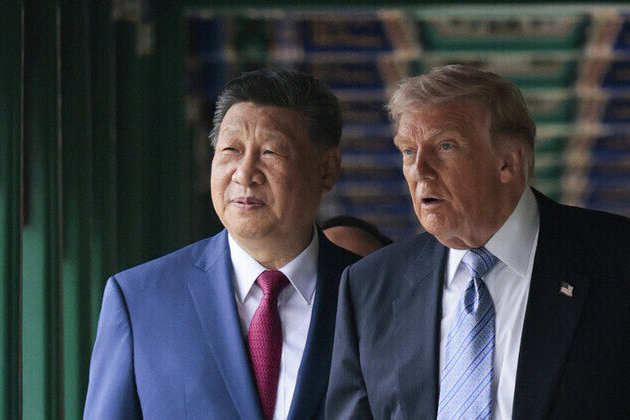
Last week's Trump-Xi summit produced no dramatic declaration or historic treaty - yet its importance may prove far greater than any immediate deliverable. What happened in Beijing was not a breakthrough in policy but a breakthrough in recognition: the United States openly acknowledged China as an equal center of global power. That alone marks a historic turning point.
For decades, American administrations approached China from the assumption that Beijing was either a manageable challenger or a state that would eventually integrate into a US-led international order on American terms. The summit suggested something fundamentally different.
US President Donald Trump appeared compelled to recognize that China is no longer simply a rival great power but a central pillar of the emerging world order - one that Washington can neither isolate nor overpower. This was the true message of the summit.
The triumph of pragmatism
Neither Washington nor Beijing expected immediate breakthroughs. The summit was never realistically supposed to solve structural tensions overnight. Its purpose was to stabilize relations between two powers which are increasingly aware that prolonged escalation has become prohibitively costly.
The talks reflected the reality that the US now needs stable engagement with China as much as China needs stable engagement with the US. This mutual dependency is perhaps uncomfortable, but it is also unavoidable - neither full confrontation nor full separation is sustainable anymore.
For years, the Americans described China as a revisionist actor seeking to overturn the international order. But the Beijing summit demonstrated something more consequential: the international order itself is already changing. Many countries have begun treating China not merely as a competitor to the US, but as a parallel - and in some respects superior - center of global gravity.
That transformation explains Trump's increasingly pragmatic posture. Competition with China remains intense, particularly in trade and technology, but the White House no longer appears interested in fantasies of regime change or direct strategic rollback against Beijing. More importantly, Washington may no longer possess the power necessary to pursue such ambitions successfully.
America's new grand strategy
The summit also revealed the outlines of Trump's evolving geopolitical doctrine. Contrary to alarmist rhetoric on both sides of the Pacific, Washington's strategy increasingly appears less focused on destroying China's rise than on managing coexistence while preserving maximum American leverage. The emphasis has shifted from ideological crusades to economic and technological competition.
At the same time, the US seems determined to tighten strategic control over the Western Hemisphere in a manner reminiscent of the Monroe Doctrine. Recent developments in Panama and Venezuela, alongside growing pressure on Cuba, should be understood through this lens. Washington seeks uncontested primacy in the Americas while reducing external dependence and limiting Chinese penetration into its natural sphere of influence.
This strategy undoubtedly weakens Beijing's position in Latin America. Yet paradoxically, it also reflects the logic of multipolarity. Trump's America increasingly appears willing to accept Chinese dominance in certain areas, provided the US retains dominance in others.
The same applies in the Indo-Pacific. Washington continues to supply weapons to Taiwan, Japan, and other regional partners while encouraging broader militarization across the region. But this should not automatically be interpreted as preparation for direct confrontation. It may instead represent a rebalancing of strategic burdens - an effort to share military responsibility among allies while avoiding a catastrophic US-China war over Taiwan or other flashpoints.
The Iran exception
One major contradiction remains: the Middle East. Trump's broader strategy points toward selective engagement, hemispheric consolidation, and managed competition with China. Yet the war against Iran appears strikingly inconsistent with that idea.
Strategically, it resembles an aberration - a costly diversion driven less by core American interests than by the influence of Israel and the priorities of Israeli Prime Minister Benjamin Netanyahu. In many respects, it's more Netanyahu's war than Trump's war.
Unlike Washington's moves in the Americas, which constrained Chinese influence, instability in the Middle East may actually strengthen Beijing's global position.
China benefits when the US gets trapped in expensive, open-ended regional crises. Every additional military commitment dilutes American focus and accelerates the redistribution of global influence. Beijing, meanwhile, continues to present itself as a comparatively stable economic partner with a mature and modern political system capable of engaging all sides simultaneously.
While Washington attempts to contain China economically and strategically, its own Middle Eastern entanglements may be helping Beijing expand its international stature far beyond the Gulf region.
This, in turn, reinforces Beijing's confidence at the negotiating table. China now approaches talks with the US not as a rising power seeking acceptance, but as an established force convinced that time increasingly favors its long-term game.
From confrontation to coexistence
Perhaps the clearest evidence of this transformation lies in official American doctrine itself. A comparison between Trump's 2017 National Security Strategy and the 2025 version released last November reveals a remarkable evolution in Washington's thinking.
The 2017 document portrayed China as a strategic threat, a revisionist power undermining American security and prosperity. Beijing was grouped alongside Russia, Iran, North Korea, and jihadist terrorism as one of the principal dangers ostensibly facing the US. China's political system and values were described as fundamentally incompatible with American interests.
The new strategy is dramatically different. The 2025 National Security Strategy focuses primarily on trade imbalances, economic competition, and maintaining strategic equilibrium. China is no longer explicitly framed as a security threat. Ideological language has given way to that of balance, competition, and coexistence.
This is not a cosmetic adjustment. It reflects a profound strategic recalibration. Washington increasingly understands that China cannot be isolated, economically decoupled, or politically transformed through pressure alone. The costs would simply be too high - not only for China, but for the US itself.
'Constructive strategic stability'
The Trump-Xi summit therefore may represent the beginning of a broader search for what Beijing calls "constructive strategic stability." Not friendship, and certainly not alliance. But a structured coexistence between two systems competing intensely while recognizing mutual limits.
In many ways, this also validates Chinese President Xi Jinping's long-standing assertion that "the great rejuvenation of the Chinese nation and making America great again can go hand in hand." Until recently, such statements were dismissed in Washington as propaganda. Now it increasingly resembles the conceptual foundation of an emerging geopolitical compromise.
The next stage of this process may arrive sooner than expected. Xi will travel to Washington in September - a highly symbolic visit given that he never visited the US during Trump's earlier presidency.
If that meeting takes place, it will confirm what the Beijing summit already suggested: the era when Washington could dictate the terms of the global order unilaterally is ending. A new world is emerging, shaped by negotiated coexistence between rival centers of power.
For the first time in decades, the United States appears ready to admit it.
(RT.com)



 Share
Share
 Tweet
Tweet
 Share
Share
 Flip
Flip
 Email
Email