Xinhua
24 Jul 2026, 07:16 GMT+10
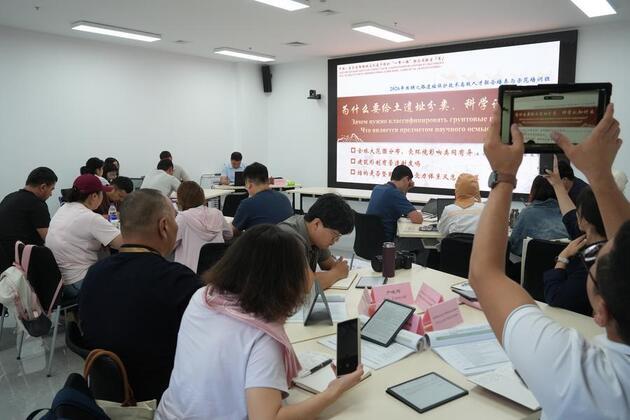
LANZHOU, July 24 (Xinhua) -- In a conference room in Dunhuang, a vital ancient Silk Road hub in northwest China's Gansu Province, a lecture explored China's various earthen heritage sites and the scientific study of traditional craftsmanship. As images of these relics popped up on screen, Kyrgyz trainee Emirlan Myrzabekov snapped photos via his phone, while jotting down key takeaways in a notebook.
A heritage researcher, manager and educator at Kyrgyzstan's Sulaiman-Too National Historical and Archaeological Museum, Myrzabekov has come to China for the first time as one of the 25 participants in the 2026 international training program on Silk Road heritage conservation.
Hailing from five countries including China, Kyrgyzstan and Uzbekistan, the trainees, averaging around 30 years old, are young scholars, researchers and technicians already working in or preparing to enter cultural heritage conservation.
The 40-day training endeavor runs until Aug. 21 and features a curriculum covering Silk Road heritage overview and relevant laws and regulations, scientific research and testing of traditional craftsmanship, heritage deterioration mechanisms, monitoring and early warning, core conservation technologies and standards, and field studies at major heritage sites along the Hexi Corridor.
In addition to classroom learning, the participants will conduct experiments and carry out on-site investigations at a number of heritage sites.
Since the program started a week ago, Myrzabekov has absorbed a wealth of new knowledge. The lectures blend theory with practical demonstrations of conservation technologies, resources he sees as highly applicable to his work in Kyrgyzstan.
During a recent visit to the Great Wall sections in Dunhuang, he was deeply impressed by China's approach to integrating heritage conservation and tourism. He pointed out that reconciling heritage protection with urban construction amid rapid urban growth poses a major challenge for Kyrgyzstan, and China's experience provides important lessons.
Sulaiman-Too Mountain, where he is based, earned UNESCO World Heritage status in 2009. "Heritage of this kind requires extensive conservation work and international participation," Myrzabekov remarked, expressing his wish to pursue closer ties with Chinese cultural heritage institutions.
Beyond the courses, Abdulkhay Abduganiev, a 28-year-old doctoral student at the Samarkand Institute of Archaeology in Uzbekistan, has brought his own research questions to Dunhuang.
Abduganiev has long studied medieval Sogdian culture. He said that Uzbek historical records contain accounts of Sogdian people traveling to China during the Tang Dynasty (618-907), while Dunhuang manuscripts hold abundant materials on the Sogdian history.
"This time, I hope to find opportunities to consult Chinese scholars on these subjects," he said.
Ancient city sites along the Silk Road vary widely in form and boast outstanding historical value, with many facing conservation challenges that are similar and yet distinctive to each site. In recent years, China and Central Asian countries have launched multiple cooperative initiatives covering heritage surveys, monitoring and preservation.
Their joint efforts yielded a landmark achievement in 2014, when a joint application by China, Kazakhstan and Kyrgyzstan led to the recognition of "The Silk Roads: The Routes Network of Chang'an-Tianshan Corridor" as a UNESCO World Heritage Site.
In 2017, the Dunhuang Academy signed a memorandum of understanding with a cultural heritage institution in Kyrgyzstan, carrying out joint field investigations and academic exchanges ever since. Drawing on over 80 years of experience in cultural heritage conservation, the academy has developed expertise in safeguarding murals, cave temples, earthen sites and other rock-and-soil heritage. It has also cultivated Russian-speaking professionals to bolster collaboration with Central Asian countries.
A China-Kyrgyzstan Belt and Road joint laboratory on cultural heritage conservation was approved by China's Ministry of Science and Technology in 2025 to advance cooperation in heritage surveys, conservation technologies, professional training and academic exchanges.
In February this year, the laboratory launched a platform in Bishkek, the capital city of Kyrgyzstan. Centered on the ancient city of Suyab, the platform delivers technical support ranging from rapid diagnosis, surveying and mapping to remote monitoring and early warning.
Guo Qinglin, director of the Dunhuang Academy, noted that the roughly 200-square-meter facility is equipped with over 50 sets of professional instruments, while the academy dispatches two to three teams annually to collaborate with Kyrgyz researchers and conservators.
During the ongoing training in Dunhuang, Nazira Duishombekova, 26, the joint laboratory's deputy secretary-general from Kyrgyzstan, has discussed pressing issues surrounding Suyab with Chinese researchers.
Duishombekova, from Kyrgyzstan's Ministry of Culture, Information and Youth Policy, said the country hosts numerous medieval sites but lacks sufficient in-depth research and trained specialists in conservation, testing and long-term monitoring. Ancient civilizational exchanges stretching thousands of years form a solid foundation for the two countries to jointly protect heritage and nurture talent.
Among the Chinese experts she met was Pei Qiangqiang, a Dunhuang Academy research fellow who has visited Kyrgyzstan seven times and participated in the construction of the joint laboratory and conservation work at Suyab.
He believes bringing young professionals together enables them to compare conservation practices and challenges and explore shared solutions.
"Training professionals builds grassroots ties between China and Central Asia. It is a long-term undertaking," Pei said.
Get a daily dose of Milwaukee Sun news through our daily email, its complimentary and keeps you fully up to date with world and business news as well.
Publish news of your business, community or sports group, personnel appointments, major event and more by submitting a news release to Milwaukee Sun.
More InformationBUDAPEST, Hungary: Hungary's former nationalist prime minister Viktor Orbán, who lost power after 16 years in an election in April,...
DUBAI/MANILA: Four more oil tankers changed direction on the Red Sea after Iran-aligned Houthi forces in Yemen warned ships not to...
ISLAMABAD, Pakistan: On July 21, diplomats tried to save a temporary agreement between Iran and the United States that had broken down,...
SINGAPORE: Singapore's Acting Minister-in-charge of Muslim Affairs, Faishal Ibrahim, resigned from his position over his interactions...
BEIRUT, Lebanon: Lebanese army troops began moving into the southern town of Zawtar al-Gharbiyeh on July 21 after Israeli forces pulled...
BANGKOK, Thailand: Scam gangs cheated people across the Asia-Pacific region out of at least US$88 billion in 2025, a United Nations...
(Photo credit: Denis Poroy-Imagn Images) The New York Mets return home for the first time since the All-Star break, starting a three-game...
(Photo credit: Jeff Hanisch-Imagn Images) The Milwaukee Brewers will look to continue their second-half surge behind rookie left-hander...
(Photo credit: Mark Hoffman / Milwaukee Journal Sentinel / USA TODAY NETWORK via Imagn Images) Lauren Coughlin and South Korea's...
(Photo credit: Brian Fluharty-Imagn Images) A four-run first inning helped the visiting Baltimore Orioles earn a 5-1 victory over...
(Photo credit: Vincent Carchietta-Imagn Images) Arizona Cardinals: Does new coach Mike LaFleur have a QB1 in the building? Contenders...
(Photo credit: Mark Hoffman/Milwaukee Journal Sentinel / USA TODAY NETWORK via Imagn Images) Joey Ortiz ripped a two-run triple,...