RT.com
01 Aug 2026, 00:17 GMT+10
Spains response to Ceuta should go beyond fences and fear, and turn crisis management into a new partnership with Africa.
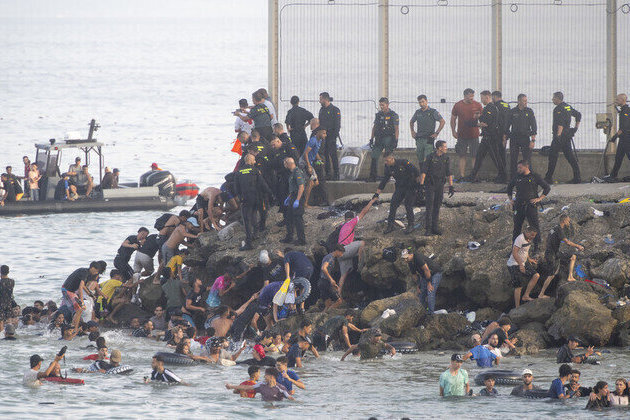
The events unfolding in Ceuta should not be reduced to the familiar European language of invasion, emergency and border control. From a Pan-African perspective, what we are witnessing is the human consequence of a profoundly unequal economic relationship between Africa and Europe.
Spain now has an opportunity to move away from the conventional European model of engagement with Africa and learn from the partnerships developed by countries such as China, Russia, Brazil and India. These relationships are not without problems or contradictions. Nevertheless, they have generally approached African countries as political and economic partners, supported infrastructure and productive development, and recognised Africa as an emerging centre of global power rather than merely a source of raw materials, migration and insecurity.
Spain can draw lessons from these experiences while developing its own distinctive partnership with Africa, based on geographical proximity, historical connection, mutual development and respect for African sovereignty.
Young Africans do not risk their lives at sea because Europe possesses higher fences. They do so because the present international economic system has concentrated opportunity, capital and mobility on one side of the Mediterranean while denying them on the other.
Spain must, of course, protect its borders, preserve public order and ensure the safety of the people of Ceuta. No responsible African position requires Spain to surrender its sovereignty or tolerate disorder. Nevertheless, security measures alone cannot resolve what is fundamentally a question of development, dignity and economic justice.
Under its current government, Spain has increasingly demonstrated a willingness to distance itself from some of the harshest and most arrogant tendencies of mainstream European and North American foreign policy. It has shown greater sensitivity towards the Global South, defended international law in difficult circumstances and spoken of Africa not merely as a source of migration or insecurity, but as an equal strategic partner.
Spain's official Africa Strategy for 2025-2028 speaks of mutual respect, shared benefit, responsible investment, youth employment and a relationship conducted "from equal to equal." These principles deserve recognition and support. They must now be transformed from diplomatic language into economic reality.
Spain's relationship with Africa is also distinctive. It is certainly not free from the history of colonialism, military confrontation and political inequality. No honest African analysis should conceal this. Yet Spain's connection with Africa cannot be defined exclusively by colonialism.
Spain and Africa are geographical neighbours. They share Mediterranean and Atlantic spaces, centuries of human movement, commercial exchange and profound cultural interaction. Much of Spanish history, language, architecture, agriculture, music and identity was shaped through its relationship with North and West Africa.
Africa is therefore not a distant region lying beyond Spain's strategic horizon. It is part of Spain's immediate historical and geographical environment. This gives Spain an opportunity to lead Europe towards a different relationship with the continent.
The dominant Western approach has too often treated Africa through four narrow lenses: minerals, migration, terrorism and geopolitical competition. African countries are approached when their resources are required, when their votes are needed, when their young people arrive at European borders or when Western powers fear the growing influence of China, Russia and other actors.
Spain can offer another path. It can support African industrialisation rather than importing African raw materials. It can encourage joint ventures, technology transfer and local production rather than relationships based on extraction. It can invest in African agriculture, renewable energy, transport, education, digital infrastructure and manufacturing while ensuring that employment and value remain inside Africa.
It can also expand legal mobility, university exchange, vocational training and circular migration so that movement between Africa and Spain becomes organised and mutually beneficial rather than dangerous and controlled by smugglers.
Africa does not require charity. It requires investment without domination, cooperation without paternalism and trade that allows African societies to produce, manufacture and prosper.
The long-term answer to Ceuta is therefore not simply a larger wall. It is the creation of an economic space in which a young African does not have to cross a border illegally to imagine a dignified future.
At the same time, African governments must accept their own responsibilities. They must confront corruption, economic exclusion, unemployment and the failure to provide their youth with credible opportunities. Pan-Africanism cannot place every failure at the feet of Europe while exempting African elites from accountability.
Spain should reject the politics of fear that turns desperate human beings into an invading army. African states should reject the political manipulation of migration and prevent vulnerable young people from being used as instruments of diplomatic pressure.
The crisis offers Spain a choice. It can follow the conventional European response: more fear, more militarisation and more distance from Africa. Or it can remain faithful to the better principles it has recently articulated and help construct a new relationship between Europe and the African continent.
From a Pan-African perspective, Spain should be encouraged to choose the second road. But genuine leadership will not be measured by how effectively Spain closes the gate. It will be measured by whether Spain helps build a world in which fewer people are forced to knock desperately upon it.
(RT.com)
Get a daily dose of Milwaukee Sun news through our daily email, its complimentary and keeps you fully up to date with world and business news as well.
Publish news of your business, community or sports group, personnel appointments, major event and more by submitting a news release to Milwaukee Sun.
More InformationDUBAI/CAIRO: The United States carried out fresh airstrikes in the Middle East on July 29, its first since pausing a bombing campaign...
ROME, Italy: Nearly 40 years after the Chernobyl nuclear disaster spread radiation across Europe and led Italy to abandon nuclear power,...
DUBAI, U.A.E.: Oman has put forward a new plan, supported by Middle East countries, to manage the Strait of Hormuz. The plan includes...
TOKYO, Japan: A strong earthquake measuring 7.1 hit Kumamoto in southern Japan on July 28. It caused widespread damage, cut power to...
ZURICH, Switzerland: FIFA is seeking support from its 211 member associations for a proposal to create a new commercial subsidiary...
HONG KONG: China moved tourists out of the famous Jiuzhaigou scenic area on July 27 after heavy rain caused mudslides, according to...
(Photo credit: Jeff Hanisch-Imagn Images) The Green Bay Packers activated tight end Tucker Kraft from the physically unable to perform...
(Photo credit: Kirby Lee-Imagn Images) CBS Sports has placed No. 1 football analyst Tony Romo on indefinite leave following his arrest...
(Photo credit: Denis Poroy-Imagn Images) Rookie Daniel Susac didn't hit a home run in his first 44 major league games. The San...
(Photo credit: Jeff Hanisch-Imagn Images) A.J. Minter threw a perfect inning in what became his finale with the New York Mets on...
(Photo credit: Denis Poroy-Imagn Images) Daniel Susac homered and knocked in three runs Thursday night while Robbie Ray sailed through...
(Photo credit: Jesse Johnson-Imagn Images) Two teams at the opposite end of the baseball spectrum face off when the National League...