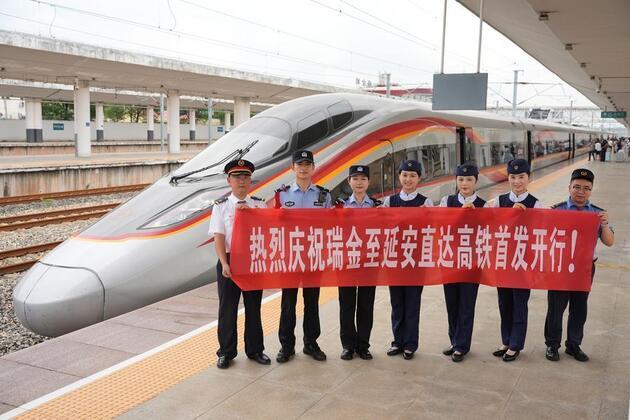
* On Sunday morning, the high-speed train G3998 departed from Ruijin City in east China's Jiangxi Province, bound for Yan'an City in northwest China's Shaanxi Province, linking the two revolutionary sacred sites by high-speed rail for the first time.
* The new rail line serves as a vital artery connecting eastern China with the city clusters in the northwest. It has forged an important corridor for economic exchange and created an efficient and convenient bridge for domestic and international travelers to visit the two major revolutionary sites of the Long March in person, and to gain a deeper understanding of China's journey from hardship to rejuvenation.
* Over the years, the Chinese government has continuously increased support for the old revolutionary base areas and steadily improved the transportation backbone network. Ruijin and Yan'an have both developed integrated, multi-modal transport networks covering aviation, high-speed rail and expressways, achieving a historic transformation in their transport landscapes.
NANCHANG, Sept. 6 (Xinhua) -- As the train pulled out of Ruijin Station and wound through rolling hills, 67-year-old Liu Ying leaned against the window, softly humming a melody she had known since childhood -- one that evokes the spirit of the epic Long March that shaped modern China more than 90 years ago.
Her grandfather, Liu Jinchang, was among the more than 86,000 soldiers of the Central Red Army who set out on the Long March in October 1934. He never returned.
On Sunday morning, the high-speed train G3998 departed from Ruijin City in east China's Jiangxi Province, bound for Yan'an City in northwest China's Shaanxi Province, linking the two revolutionary sacred sites by high-speed rail for the first time. The journey, which used to take up to 22 hours with multiple transfers, now takes just about 11 hours on the 1,857-km route.
Liu never met her grandfather, but she spent years tracing his footsteps. In 2014, while visiting a memorial park in south China's Guangxi Zhuang Autonomous Region, she found his name etched among more than 1,000 fallen soldiers from her hometown of Yudu County, Jiangxi. Tears streamed down her face.
"My grandfather set out from Ruijin, but he never made it to Yan'an. Today, I'm following the route he took northward, finishing the journey he couldn't complete and seeing the Yan'an he never got to see," Liu said.
FROM FOOT TO TRACK
Ruijin and Yan'an are both landmarks in China's revolutionary history. Located in eastern and northwestern China respectively, they are separated by a straight-line distance of over 1,300 kilometers, yet bound together by the Long March. More than 90 years ago, the Central Red Army set out from Ruijin and marched 12,500 kilometers through countless trials and perils to reach northern Shaanxi.
The new rail line serves as a vital artery connecting eastern China with the city clusters in the northwest. It has forged an important corridor for economic exchange and created an efficient and convenient bridge for domestic and international travelers to visit the two major revolutionary sites of the Long March in person, and to gain a deeper understanding of China's journey from hardship to rejuvenation, said Wang Tao, a researcher at the China Executive Leadership Academy, Yan'an.
The train is an ultra-long cross-line high-speed service, pieced together across seven railway sections and traversing the provinces of Jiangxi, Hubei and Shaanxi. Previously, no direct train or flight connected the two cities, requiring passengers to transfer at least twice. The new service has cut travel time from up to 22 hours to about 11 hours, said Ye Ronggen, an official with China Railway Nanchang Group Co., Ltd.
At the end of 2025, the Xi'an-Yan'an high-speed railway opened, formally integrating Yan'an into the national high-speed rail network. On June 30, 2026, the Xi'an-Shiyan high-speed railway began operations, completing the full Wuhan-Xi'an high-speed corridor. With these high-speed links now seamlessly connected, the distance between northwestern and central China has been sharply reduced, and a direct high-speed rail passage between Ruijin and Yan'an has been opened.
On board the high-speed train on Sunday were dozens of descendants of Red Army veterans, like Liu Ying, each carrying their family's memories and stories as they headed toward the same destination.
"Grandpa walked the entire Long March in straw sandals. Today, I'm taking the high-speed rail to follow in his footsteps, to see Yan'an with my own eyes," said Wang Wanping, a descendant of Red Army veteran Wang Rushen, clutching his grandfather's old photograph and a commemorative medal. Inspired by his grandfather's teachings, Wang Wanping has devoted himself to education for many years and has taught at a remote primary school in Ruijin.
Wu Jiancai, deputy secretary of the Party branch of the Xi'an-Yan'an high-speed Railway Project Department, China Railway 21st Bureau Group Co., Ltd., had participated in the construction of both the conventional Xi'an-Yan'an railway and the high-speed line.
He said that while the routes' length and speed have changed, the drive to build roads through mountains and bridges across waters has remained unchanged. Once his current project wraps up, he said, he plans to take the high-speed train from Yan'an to Ruijin to see for himself the monumental changes the railway has brought to the old revolutionary base areas.
NEW ROUTE, NEW PROSPECTS
No sooner had Yu Qiumei, deputy director of Ruijin's bureau of culture, radio, television and tourism, learned of the new direct high-speed rail service to Yan'an than she picked up the phone to call her counterparts in the northern city.
On Sunday, Ruijin sent a delegation of red education institutions, travel agencies, hotel operators and scenic spot managers north for inspection, and on Monday, Yan'an would send its own delegation south to Ruijin via the high-speed train to sign a framework cooperation agreement.
"Revolutionary bases joining hands for development is seriously compromised if transport links are inadequate," Yu said. She recalled her 2022 trip to Yan'an, which involved a train to Nanchang, a flight to Xi'an, and then a connecting drive. The journey took an entire day. Now, she said, one can enjoy the scenery all the way and arrive in Yan'an just by nightfall.
The bureau also plans to hold promotional events in major cities along the route, including Wuhan and Xi'an, to boost red tourism in the city.
Song Xuelin, deputy director of Ruijin's development and reform commission, suggested using tourism as a starting point, with cooperation extended to industry, rural revitalization and talent exchange. The train is transforming a transport link into a flowing economic and cultural tourism belt, Song added.
Over the years, the Chinese government has continuously increased support for the old revolutionary base areas and steadily improved the transportation backbone network. Ruijin and Yan'an have both developed integrated, multi-modal transport networks covering aviation, high-speed rail and expressways, achieving a historic transformation in their transport landscapes.
Ruijin, once a landlocked place with no access to rivers or the sea, now has an operational airport, a functioning inland port, and high-speed trains passing through, allowing investors from the Guangdong-Hong Kong-Macao Greater Bay Area to arrive by rail.
Yan'an, situated on the Loess Plateau, has seen its transportation upgrade and tourism industry boosted by high-speed rail. In the first half of this year, Yan'an Railway Station handled 2.329 million passenger departures and 2.327 million arrivals, both up by over 30 percent year on year.
Red-themed study tours, Party-related exchanges, family visits and business travel between the old revolutionary bases in southern Jiangxi and northern Shaanxi have been growing increasingly close, with demand for point-to-point direct services rising steadily. The railway authority will further optimize capacity deployment to facilitate a faster flow of passengers, goods and information between the two cities, according to China Railway Nanchang Group Co., Ltd.



 Share
Share
 Tweet
Tweet
 Share
Share
 Flip
Flip
 Email
Email