By Jeff Oloizia for Madison Magazine.
Broadcast version by Judith Ruiz-Branch for Wisconsin News Connection reporting for the Pulitzer Center-Public News Service Collaboration
In the summer of 2024, I was vacationing with family in Door County. It was a Friday afternoon, and while deep fryers in taverns and VFW halls across Wisconsin hissed in anticipation of battered fish, I was several miles off the coast of Sturgeon Bay aboard a charter boat on Lake Michigan. The fishing trip had been my mom’s idea. I was skeptical — the excursion was expensive, and I wasn’t convinced my weak stomach could handle the lake’s chop — until something heavy struck my line.
The reel screamed. I leaned back and cranked against it, slow and steady, for what felt like hours. When I finally hauled the fish over the rail — a gleaming king salmon, as long as a toddler — I felt a rush of triumph that quickly gave way to something else. Clinging to the fish’s belly was a slick, black parasite, writhing like something cursed.
“What the hell is that?” I asked our guide.
“Lamprey,” he said, peeling it off to reveal a funnel of razor-sharp teeth like you’d see in the sandworms of “Dune.”
Sea lampreys aren’t new to these waters; they arrived in the early 1900s, slipped in through human-made canals, and never left. They latch onto fish, boring into flesh to feed on tissue and blood. A single adult can kill up to 40 pounds of fish in its lifetime. For decades, scientists kept them largely in check with lampricide. But warming waters and shifting lake conditions have complicated those efforts, helping the parasites spread once again.
The lamprey is only part of the story. Across the Great Lakes, climate change is reshaping the rhythms that native fish have followed for centuries. Warmer waters and early thaws are scrambling the spawning calendars of walleye, yellow perch and whitefish. Migrations are mistimed. Eggs hatch too early or fail to hatch altogether. The native fish species that fed generations of Wisconsinites — at church suppers, family cookouts and Friday night fish fries — are vanishing from local waters.
To the occasional angler, it’s an annoyance. To the state that built a cultural ritual around its waters, it’s something more profound: not an ending, exactly, but a gradual separation between the tradition and its origin.
Of course, I didn’t know any of this when I reeled in that salmon. Like many Wisconsinites, I rarely thought about where the fish on my plate came from. Earlier this year, Madison Magazine surveyed readers about their fish fry habits. More than half said local sourcing was of little or no importance to them.
What I did have was a deep attachment to the fish fry ritual itself: Friday nights at Alioto’s in Wauwatosa with my grandparents eating endless plates of perch, or afternoons on Mildred Lake near Rhinelander, where a family friend fried bluegill after long days of fishing with my dad. Those meals felt timeless then, inseparable from Wisconsin itself.
But, like the parasite itself, my encounter with the lamprey refused to let go. It pushed me to look more closely at where my food comes from and at the environmental forces reshaping its habitat.
Over the past 12 months, I’ve spoken with chefs, anglers, tavern owners and scientists across Wisconsin. I’ve pulled nets with DNR conservation crews, sat shoulder to shoulder with fish fry regulars and even attended a two-hour church basement production called “Fish Fry The Musical.”
This is a story about fish, but it’s also about the uneasy realization that even our most familiar traditions depend on ecological conditions we can no longer assume will hold. The fish fry is imagined as a celebration of Wisconsin waters, yet many of the fish served today come from somewhere else entirely. As the state’s lakes continue to warm and its fisheries change, that contradiction becomes harder to ignore.
One of the nerve centers of fish fry culture in Madison, if not all of Wisconsin, is Dexter’s Pub. An eastside institution, the bar serves fish fry twice a week: a so-called “mini” offering on Wednesdays (cod and walleye) and the full spread of cod, lake perch, walleye, shrimp and salmon on Fridays.
On a Friday this spring, the place pulsed with activity. By 6 p.m., the wait for a table stretched close to an hour. Thirsty patrons stood three deep at the bar. Servers weaved through the dining room carrying plates piled with fried fish, french fries, coleslaw and rye bread. In the open kitchen, visible from my seat at the bar, Colin Bauman (former chef at Dexter’s, now sous chef at Everly) and his staff dredged fillets in paprika-tinted batter before lowering them into bubbling oil and then stuffing black takeout containers as fast as they could. The large flat-top griddle, usually a crime scene of fat and ground beef, gleamed untouched.
Dexter’s makes nearly half its total revenue on Fridays. (“If we have a regular week and a regular Friday, then it’s like, 40, 45% percent,” Bauman told me, “which is still crazy for one night.”) When I returned the following Monday — technically the restaurant’s day off service — Bauman and his staff were already preparing for the week ahead.
“Every bit of my energy [on Mondays] is, like, make sure I have cod,” Bauman said.
For decades, that wasn’t much of an issue. Despite its reputation as a tradition rooted in Wisconsin’s lakes, the fish fry has long depended on global supply chains. Imported cod remains the backbone of most menus; much of the walleye served is imported as well, often from Canadian fisheries. Kristin Hueneke, chef at Lakefront Brewery in Milwaukee, told me she goes through roughly 300 pounds of cod a week, compared to just 30 pounds of walleye. In recent years, however, restaurants say even imported fish has become more expensive and, increasingly, harder to source consistently. Supplies of cod and Canadian walleye have tightened, and prices have soared.
Bauman, a self-described meticulous tracker of food supply trends, pulled up the ordering site he uses for fish.
“From the same company, we’ve been able to get — every single week — the same frozen Pacific cod,” he said. “One year ago today, I was paying $56.72 for a 10-pound box. Right now, that same cod — which, for the record, I can’t even buy [because it’s out of stock] — is $70.15.”
Two years ago, Bauman switched from Atlantic cod to Pacific cod — much of it caught in Alaska, processed in China and shipped back to the United States — to blunt rising costs. He anticipates a day when Atlantic cod disappears from menus altogether. Scientists have warned for years that warming ocean temperatures in the Gulf of Maine and North Atlantic are stressing cod populations and complicating their recovery from years of overfishing. In response to declining stocks, regulators have repeatedly tightened catch limits on Atlantic cod, driving up prices and pushing many restaurants toward cheaper alternatives.
Every once in a while, Bauman said, a customer will insist they want Icelandic Atlantic cod rather than the Pacific cod that now appears on many fish fry menus. Atlantic cod tends to be flakier, with a slightly sweeter, richer taste, while Pacific cod can be leaner and more neutral. “It’s like, okay, but you can’t get that without paying $23,” Bauman said. “If someone’s doing $15 Icelandic cod, I have follow-up questions.”
Earlier this year, I connected with seven Wisconsin establishments serving fish fry about sourcing availability. Five reported significant increases in fish prices in recent years. None said prices had stayed the same or gone down.
Customers have noticed, too. Two decades ago, a fish fry dinner often cost around $10. In Madison today, a similar plate pushes past $20 — a price increase that still outpaces inflation.
As prices rise, some of the species most closely associated with Wisconsin fish fry have become increasingly scarce.
In the first half of the 20th century, yellow perch were so abundant and inexpensive in the Great Lakes region that fish fries became one of the cheapest ways for taverns to attract customers. But Lake Michigan’s perch fishery collapsed in the 1990s, undone by a combination of overfishing and invasive species. Zebra and quagga mussels devoured the plankton at the bottom of the food chain, while alewives competed with young perch for what remained.
Scientists say warming waters have since added another layer of stress, reshaping spawning patterns and creating conditions that favor invasive species across the Great Lakes. What was once one of the world’s most productive yellow perch fisheries went bust.
As a result, many restaurants quietly substitute. Zander, a fish found in brackish and freshwater in western Eurasia with much larger fillets than yellow perch, now shows up on menus, as does ocean perch, a saltwater species that has little in common with yellow perch beyond the name. In many cases, customers don’t know the difference.
But Mike Seidel, a lake perch enthusiast who runs the website madisonfishfry.com, has learned to identify subtle tells.
“Lake perch has a very specific connotation,” Seidel told me over lunch. “I’ll say, ‘How many fillets are there?’ And the waitress will say, ‘Oh, you get two big ones.’ As soon as she says ‘big ones,’ I’m out.”
While Bauman is open about serving perch from Estonia and Lithuania — other establishments, like the nearby Villa Tap, manage to get yellow perch from Lake Erie — some restaurants have chosen to stop buying the fish altogether, citing difficulties in managing quality control.
“I wasn’t finding the quality product that I remember,” said Hueneke, who eventually removed perch from Lakefront Brewery’s menu. “The flavor was fine, but you don’t want this teeny tiny piece of meat.”
A similar thing has happened with smelt. The tiny, snack-sized fish, long served by the bucketful at VFWs and sportsmen’s clubs, have grown increasingly hard to come by in recent years as invasive mussels and warming waters disrupt Lake Michigan’s ecosystem. The population has declined so sharply that, in 2015, the Detroit Free Press declared a “smeltdown.”
Bauman had planned to offer smelt at Dexter’s during Lent this year but was frustrated when his supplier delivered a smelt-like ocean fish called silverside instead. He tried to use it but found that, unlike smelt, the silverside had a spine that was “hard and crunchy.”
“There are hardly any regulations on what you have to call it,” Bauman said, referring to seafood-labeling rules that allow suppliers to market some similar-looking fish under broad or interchangeable names. While a handful of species are subject to stricter federal naming standards, he told me that in most cases, suppliers can market fish under any name they want.
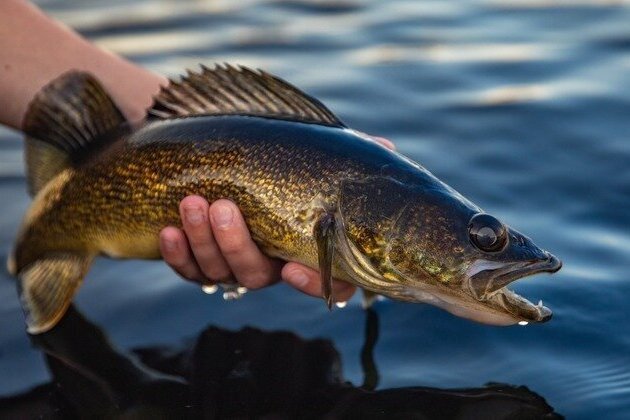
Perhaps no species better captures what’s happening in Wisconsin’s lakes than the walleye. Long a fish fry staple, particularly in the western part of the state, the cool-water species has experienced population declines across many Wisconsin lakes over the past several decades, driven — at least in part — by warming waters and habitat loss.
Take Escanaba Lake in Vilas County, for example. For generations, lakes like Escanaba sustained Wisconsin’s Friday fish fry. Since 1946, more than 135,000 walleye have been harvested from its waters. But by 2003, the walleye harvest had effectively disappeared. Studies have shown that more erratic winters — with freezes arriving later and ending sooner — disrupt spawning cycles and reduce the survival rates for young fish.
Escanaba is part of the Northern Highland Fishery Research Area, or NHFRA, one of the most intensively studied freshwater fisheries in the world. Anglers here are required to report every catch, while researchers record water temperatures and weather conditions multiple times a day. Earlier this year, I drove several hours north to join the Wisconsin Department of Natural Resources during its annual spring walleye survey of Escanaba Lake. That meant climbing into a small boat just after sunrise to pull fyke nets — large trap nets set along spawning routes used to generate annual population estimates.
To my untrained eye, the day’s fieldwork yielded few revelations — I spent most of the morning shivering through a late-spring cold snap — but the science emerging from Escanaba Lake and others like it is harder to ignore.
At UW–Stevens Point’s Northern Aquaculture Demonstration Facility, or NADF, in Bayfield, Wisconsin, researchers found that walleye reproduction depends heavily on prolonged cold. Fish exposed to winter temperatures around 4 degrees Celsius — the kind of temperatures typically found under ice — showed strong reproductive success. At roughly 8 degrees Celsius, however, successful reproduction is inconsistent. At 12 degrees Celsius, spawning effectively failed.
That matters because warming — which has been documented throughout the Great Lakes region — compresses the narrow band of habitat where walleye can live and reproduce. In some lakes, there may be only a few vertical feet of water with both the right temperature and an adequate supply of oxygen.
“It’s not necessarily that it gets so hot that walleye or perch can’t survive physiologically,” said Gretchen Hansen, a former Wisconsin DNR research scientist who is now an associate professor in the Fisheries, Wildlife and Conservation Biology department at the University of Minnesota. “But we’re still seeing declines before they reach that critical threshold.”
The projections are even more stark. A 2017 study led by Hansen in collaboration with the U.S. Geological Survey predicted that by mid-century, the share of Wisconsin lakes in which walleye could naturally reproduce might drop by more than half, to less than 4%. Over the same period, lakes favorable to largemouth bass — a warm-water species well suited to rising temperatures — could expand from 60% to nearly 90%.
Fish populations respond to an intricate mix of factors, including temperature, oxygen content, water clarity, forage availability, the prevalence of invasive species and fishing pressure. But as cold-water lake habitat in Wisconsin changes, species like walleye are losing ground.
By March of this year, I wanted to know whether the fish fry as we know it, with its historical reliance on native species like walleye, perch and bluegill, had any long-term plausible future as pressures on wild fisheries continued to mount. So I drove north again, this time to visit Tyler Firkus at the NADF.
As the facility’s assistant director, Firkus is part of a small vanguard of scientists studying walleye aquaculture. It was Firkus’ team that determined the temperature thresholds for walleye. He also wrote his Ph.D. dissertation on sea lampreys. If anyone could explain what was happening to walleye, it was him.
I imagined the NADF as a Midwestern version of the remote Antarctic research station from John Carpenter’s “The Thing.” I wasn’t far off. If Door County is the thumb in Wisconsin’s mitten, then Bayfield is its gnarled middle finger: remote, windblown and home to some of the state’s hardiest people. The morning of my visit, the weather had collapsed into a near whiteout.
Inside the facility, tanks crowded nearly every inch of the room. It reminded me of a brewery or a school science fair — if every project happened to involve walleye. Pipes snaked overhead. Grow lights glowed against the concrete. And at the center of it all was Firkus, bearded and bespectacled, looking like a cross between Bill Nye the Science Guy and Paul Bunyan.
In a dark section of the lab covered by a tarp, thousands of tiny walleye the size of pencil shavings carved restless patterns in side-by-side tanks. Much of existing walleye aquaculture is conducted outdoors and at high cost; every year, the Wisconsin DNR spends several million dollars raising walleye for stocking programs. These operations are so costly because the ponds have to be filled with minnows for the young walleye to eat.
Firkus’ work focuses on whether walleye can be raised efficiently in tanks at commercial scale. At the NADF, hatchlings are transitioned almost immediately onto a pelleted diet, mostly so they don’t eat each other. (“Because what they’re looking for right after they hatch is small swimming invertebrates, microorganisms, and unfortunately, the thing that looks like small swimming microorganisms are their brothers and sisters,” Firkus said.)
After the first 30 days, the survivors are moved through a series of tanks kept at different temperatures. To avoid having an entire cohort reach market size at once, researchers experimented with chilling a subset of the fish to slow their growth.
“You can keep [temperatures] low and you don’t have to feed them much because it’s cold,” Firkus explained. Once the rest of the fish were ready for market, the chilled group could be warmed back up and returned to active growth.
“In theory it sounds very simple, but really what you’re doing is manipulating the normal thermal physiology of these fish,” Firkus said. “So we wanted to see how early you can actually chill these fish down and arrest their growth without any consequences.”
The results?
Here, Firkus used phrases like “gonadal development” and “fin erosion,” making me glad I wasn’t writing a Ph.D. dissertation of my own. The point was the fish handled the process remarkably well. The team found they could chill juvenile walleye for up to 60 days without significant adverse effects. The result will need to be replicated — and a study published — before the process can be used to make commercial-scale walleye aquaculture more practical. Still, it’s a promising discovery.
Raising the fish in controlled environments shields them from invasive species and contaminants like mercury or PFAS that plague some wild populations. Compared to established aquaculture species like salmon or tilapia, however, walleye are notoriously temperamental and slow to grow.
“It takes about a year and a half to get a walleye from hatch to market size,” Firkus told me. Tilapia, by comparison, can reach market size in just a couple months.
Other freshwater species have proven even more difficult to farm at scale. Starting in 2009, the pioneering Milwaukee nonprofit and urban farm Growing Power raised yellow perch for restaurants, including Lakefront Brewery. Will Allen, the organization’s founder, told me he considered the venture a success that collapsed under the weight of its own demand.
But Lakefront Brewery’s Hueneke remembers it differently, saying the operation struggled to sustain a steady supply. “Perch are a very finicky fish,” she said. “[Growing Power] wasn’t able to keep up with my demand, and it wasn’t a processing plant.”
Chef Luke Zahm, owner of The Driftless Café in Viroqua and host of PBS Wisconsin’s “Wisconsin Foodie,” described a similar experience with another Milwaukee-based perch-farming operation. “They would sell them to you and they weren’t processed at all,” he said. “You had to gut them, descale them, fillet them.” For many restaurant kitchens, he said, that level of labor simply isn’t practical.
These examples help explain why walleye aquaculture has required extensive institutional support. To encourage would-be walleye farmers to persist through the inevitable growing pains, the NADF helps with everything from system design to stocking, even replacing lost fish free of charge. The hope is that commercial-scale walleye aquaculture may one day help fill gaps in the supply chain for one of Wisconsin’s most prized fish.
Still, when I suggested that a future where farmed walleye is widely available might not be too far off, Firkus paused.
“I mean, you really hope that it works because we’ve done a lot of research on this,” he said. “Partially because we’re fish nerds ... but also because I love eating walleye. I grew up fishing for them, eating them. When I go to a fish fry, I get upset when it isn’t on the menu.”
He watched the fish circle one of the tanks for a moment before continuing.
“There’s obviously an argument that the environment changes and we just need to adapt to it,” he said. “And there are a lot of things we can influence with management decisions. But at a certain point, it just gets harder and harder. If a lake can’t support natural wildlife reproduction [anymore], there’s no management decision that’s going to change that.”
In late April, I was back on the water. This time, I was fishing for walleye on the Fox River near Green Bay. Maybe if I could catch one of the elusive fish myself, I reasoned, it would mean they weren’t actually disappearing. It was a harebrained idea, but by then I’d spent enough time thinking about food chains to indulge in a little magical thinking.
I’d hired a guide, U.S. Coast Guard-certified captain Dan Kirk, whose website billed him as a walleye specialist. When he’s not on a boat, Kirk performs as a professional juggler at school assemblies and church festivals. He’d even appeared on “America’s Got Talent.” As we drifted down the river waiting for a bite, he told me that during an especially turbulent stretch earlier in his life, he’d felt called — clearly and unmistakably — to become a juggler.
“It was an actual voice,” he said. “The Holy Spirit told me my purpose was to be a juggler, like it was God’s plan. Imagine telling that to your dad.”
Kirk also had a standing policy: If we didn’t catch a single fish, I wouldn’t owe him anything beyond the deposit I’d put down to book the trip. This struck me as a pretty fair arrangement. Still, sitting there listening to him talk about divine purpose, I found myself wondering whether our outing might produce its own small miracle: the kind of Galilee-grade abundance typically reserved for scripture.
And then we waited. And waited.
What was the point of this? Not just the fishing trip, but the whole obsession? Climate disasters seem to be everywhere you look. New York subways filled with floodwater. Entire Appalachian towns washed away by a hurricane. Our own skies turned orange with wildfire smoke. How were people supposed to care about what was happening beneath the water’s surface when catastrophe is already in plain sight?
And yet, out there on the water, it felt impossible not to care.
As Wisconsinites, we enjoy an embarrassment of riches: 15,000 inland lakes, 84,000 miles of streams and rivers, more than 800 miles of Great Lakes shoreline. We swim in these waters, fish in them, waterski across them. Some of us hold fish fries and shore lunches on their banks. But the habitats that sustained these traditions are changing, and the fish fry’s relationship to those waters is changing with them.
Eventually, Kirk caught a few fish: a catfish, a couple white bass, a hulking sheepshead. But no walleye. I was just about to ask him to take us to shore when suddenly I felt a hit on my line. Unlike that day on Lake Michigan, the reel didn’t scream — we were fishing vertical jigs in much shallower water — but I felt the same electric jolt as the rod bent toward the dark river below.
I don’t remember whether the fight lasted 10 seconds or two minutes. When at last the fish broke the surface, I saw the torpedo-shaped body and telltale glassy eyes of a walleye. As Kirk scrambled for the net, I thought of something Hueneke had told me about why she loves fish fries: “It’s the whole vibe on Friday, the polka and the laughter. It’s all those things that I remember about going there as a kid, that now make me want to take my own kids.”
I thought about Friday nights with my grandparents at Alioto’s in Wauwatosa, and fishing on Mildred Lake with my father.
Never mind that it wasn’t walleye season and I’d have to release what I caught. I was already imagining the crackle of golden crust. The sweet, delicate flake. The kind of thing it’s easy to assume will last forever, right until it doesn’t.
Jeff Oloizia wrote this article for Madison Magazine.
Source: Public News Service



 Share
Share
 Tweet
Tweet
 Share
Share
 Flip
Flip
 Email
Email