


|
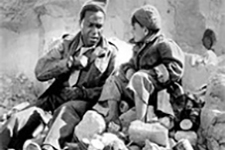 Paisan (Paisà ), Roberto Rossellini's follow-up to his groundbreaking and internationally acclaimed neorealist masterpiece Rome Open City (1945), works much of the same terrain while also extending and elaborating his aesthetic preoccupations on a much grander narrative scale. While the previous film was firmly rooted in a specific location, Paisan is a moving geographic fresco, taking us slowly northward through the Italian peninsula as six different wartime vignettes unfold—some comical, some tragic, but all deeply humane. The film also differs quite substantially from its predecessor in terms of production, as Rome Open City was made on a shoestring and shot on scraps of discordant celluloid while Paisan was funded almost entirely by Rod Geiger (an American soldier stationed in Rome who had helped get Rome Open City distributed in the U.S.) and shot on high-quality Kodak film stock. Nevertheless, even if the images are sharper and more consistent, Rossellini effectively maintains the rough-hewn, in-the-streets feel of neorealism, and in its best moments Paisan feels like something captured, rather than something produced.
The film begins in Sicily and moves steadily northward with each succeeding story, thus reflecting the actual path of the Allied liberation of Italy starting in 1943. Each of the film's narratively unrelated vignettes begins with actual newsreel footage and narration that situates it within the larger context of World War II, and each takes place in an important locale: Sicily, Naples, Rome, Florence, the Appenine Range, and finally Porte Tolle in the Po delta. The fact that half of these are urban and half are rural reflects Italy's varied spaces and also gives Rossellini a much wider canvas on which to stage his drama. While he did something similar in Rome Open City in terms of shifting from claustrophobic interiors to wide open spaces within the city, Paisan reflects a profound elaboration of neorealism's emphasis on physical location. Although Paisan is an episodic film, with each of the stories featuring completely different characters who are not connected to characters in any of the other stories, the film is tightly bound together by the theme of communication. Unlike Rome Open City, Paisan is not about the Italians' battle with the occupying Germans; instead it is about their tenuous relationship with the liberating American soldiers. Just as the film's stories gradually move northward up the peninsula, so too does each story increase the level of communication and understanding between the Italians and the Americans. This binding theme is reflected in the film's title, which is a term used to refer to someone from your own village. In essence, Rossellini is saying that the Americans, the foreign "others," became part of Italy during the liberation, which we see quite explicitly in the progress of the stories, as the film begins with cautious American soldiers and distrusting Sicilians unable to fully communicate and ends with American officers collaborating and dying side-by-side with Italian partisans, which is why the film's otherwise tragic ending is actually a paean to cooperation and respect. Rossellini makes the back-and-forth of cultural clash and eventual understanding into a profound statement about the nature of human interaction and solidarity, and even if the film is hampered at times by somewhat hammy acting (the Americans sometimes sound and act too much like a European's clichéd idea of what Americans sound and act like), it is rarely anything less than deeply moving.
Copyright © 2017 James Kendrick Thoughts? E-mail James Kendrick All images copyright © The Criterion Collection | |||||||||||||||||||||||||||||||||||

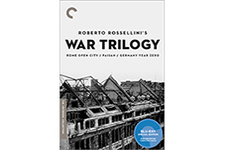 Paisan is available exclusively as part of the three-disc "Roberto Rossellini's War Trilogy" box set (SRP $99.95), which also includes Rome Open City (1945) and Germany Year Zero (1948).
Overall Rating:

 (3.5)
(3.5)
Subscribe and Follow
Get a daily dose of Africa Leader news through our daily email, its complimentary and keeps you fully up to date with world and business news as well.


News RELEASES
Publish news of your business, community or sports group, personnel appointments, major event and more by submitting a news release to Africa Leader.
More Information