


|
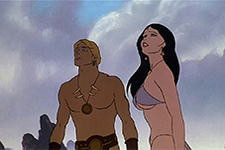
Ralph Bakshi's multi-decade career as an animator and director existed largely in the margins of Hollywood. He was defined primarily by his refusal to follow the rules of the studio system, particularly the peculiarly American assumption that animation is to be used solely for movies aimed at children. The X-rated Fritz the Cat (1972), the gritty urban drama Heavy Traffic (1973), and the blistering racial satire Coonskin (1975) made him a one-man "anti-Disney" who used ink and paint to challenge, subvert, provoke, and discomfit. But, for all his rebellion, Bakshi was regularly lured toward the mainstream, which helps explain his turn to fantasy in the late 1970s. Granted, his first foray into the genre, Wizards (1977), was a bizarre anti-war parable that mixed Nazi propaganda footage with cartoonish nymphs and conjurers, and it stands in stark contrast to his next film, The Lord of the Rings (1978), a straightforward adaptation of the first one and a half books of J.R.R. Tolkien's epic series, which was ambitious, but ultimately deemed a failure (although it clearly inspired significant portions of Peter Jackson's subsequent live-action films). Bakshi, of course, was ahead of his time, as fantasy was on its way to becoming a major genre in the early 1980s, with theaters, video stores, and cable channels glutted with both studio films like John Milius's Conan the Barbarian (1982) and Don Coscarelli's The Beastmaster (1982) and independent and foreign cheapies whose cover art suggested much more than the films themselves were able to deliver. Bakshi leaped directly into this fray with Fire and Ice, which he conceptualized in partnership with painter and illustrator Frank Frazetta, "The Godfather of Fantasy Art" whom Bakshi had met years earlier in underground comic circles. Although Frazetta worked in multiple media over the years and designed everything from movie posters to album covers, he became most famous for his pulp fantasy paintings, especially those used on the paperback covers of Robert E. Howard's Conan series. Frazetta's signature mix of exaggerated human bodies in dramatic pose and intense levels of detail created a hyperreal world that forever changed the way fantasy art was conceived. As Bakshi noted, "He's the only artist that I know that can create a painting that implies so much movement—so much action, chaos, and mood—that you swear it's actually in motion. Frank is the first fine artist to capture complex animation in a single frame." Thus, it makes sense that Bakshi would want to translate Frazetta's graphic sensibilities into an animated film, and the early 1980s was the perfect time to do it. He and Frazetta came up with a series of characters around which a script was built by screenwriters Roy Thomas and Gerry Conway, both of whom were seasoned Marvel comic book writers. Thomas much have seemed particularly appealing as he was responsible for having first adapted the character of Conan to the comic book medium as editor and primary writer for Conan the Barbarian and Savage Sword of Conan in the early 1970s. Unfortunately, little effort appears to have been put into the storyline, as Thomas and Conway delivered little more than a generic fantasy narrative that relies heavily on repetitive action sequences. Fire and Ice takes place in a Bronze Age-ish world that is slowly being consumed by enormous sheets of ice created by the evil Queen Juliana (Eileen O'Neill) and her son, Nekron (Sean Hannon), forcing humans to constantly retreat south. The ostensible protagonist is a thoroughly uninteresting loin-cloth-clad warrior named Larn (Randy Norton), who is the sole survivor of a village that was destroyed by the queen's ice. He ends up spending most of the film constantly rescuing Teegra (Cynthia Lake), the buxom daughter of King Jarol (Leo Gordon), whose volcanic kingdom Firekeep is the last refuge standing against Queen Juliana and Nekron. Larn and Teegra later team up with Darkwolf (Steve Sandor), a mysterious nomadic warrior who seeks vengeance against the ice lords (and is probably being pursued in the background by Batman's lawyers for stealing the design of his cowl). Thus, the film has all the requisite ingredients of an early '80s fantasy adventure—magic, vengeance, swords, loin cloths, almost-but-not-quite nudity—but the characters are so flat and the plot is so basic that it never rises above its oh-so-familiar parts. Teegra's constant abductions by the hoards of Neanderthal-like "subhumans" who work for Queen Juliana become almost as absurd in their regularity as her physics-defying barely-there bikini (charges of leering objectification are certainly justified, although, to be fair, Larn's body is on display just as much). The only bright spot character-wise is Nekron, whose fey, angry mama's-boy theatrics have been rightly pointed out as a fascinating departure from the paint-by-numbers plotting around him. Of course, for many the appeal of Fire and Ice is less the story and characters than the imagery drawn from Frazetta's defining style. However, there are two primary problems with how Bakshi adapted Frazetta to the screen, both of which were fundamentally inescapable at the time (and therefore call into question whether the film was a good idea at all). The first is the inability of Bakshi's style of animation to capture what is most compelling about Frazetta's paintings, which is their highly stylized detail and absolute control of light and color. The inherent simplicity of the hand-drawn cel animation and the necessity that the characters be rendered in black lines and solid colors naturally robs them of the distinct texture and nuance that keeps your eyes glued to Frazetta's canvases. The heavy reliance on rotoscoping, where the entire movie was first shot with live actors who were then traced into animation, supplies a realistic sense of movement in the cascading action sequences, but the absence of fine detail—the kind that could now be supplied by computer animation, but was unfeasible with hand-drawn cel animation in the early 1980s—is significant. This is ameliorated to some degree by the beautifully painted backgrounds, hundreds of which were produced in short order by James Gurney, who would go on to create and illustrate the celebrated Dinotopia books series, and a young Thomas Kinkade before he became known as the "Painter of Light," but it nevertheless results in a vastly simplified visual experience. Secondly, and perhaps even more importantly, the translation of Frazetta's imagery, which relies so heavily on the dynamic experience of losing yourself in frozen instance of hyper-stylized and dramatic action, into actual movement renders it shallow and monotonous. Bakshi himself nailed it when he described Frazetta's unique ability to imply motion with paint; the key is that he implies it, which allows the viewer's mind to fill in the actual action. By animating a series of characters created in the Frazetta style, Bakshi reveals them to be devoid of genuine interest outside of what they imply. It is precisely that interplay between the static painting and our desire to see it come to life that Fire and Ice kills, and without an emotionally engaging story and interesting characters to fill in the gaps, it becomes more tedious than exciting. There are moments that grip you, but once you realize there is so little at stake because the characters are so one-dimensional, it loses any hold it ever had.
Copyright © 2026 James Kendrick Thoughts? E-mail James Kendrick All images copyright © Blue Underground | |||||||||||||||||||||||||||||

Overall Rating:

 (3.5)
(3.5)
Subscribe and Follow
Get a daily dose of Africa Leader news through our daily email, its complimentary and keeps you fully up to date with world and business news as well.


News RELEASES
Publish news of your business, community or sports group, personnel appointments, major event and more by submitting a news release to Africa Leader.
More Information