


|
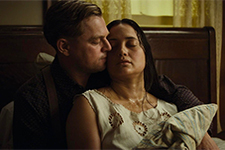
It is hard not to see Killers of the Flower Moon as the then soon-to-be-81-year-old Martin Scorsese's throwing down the gauntlet and declaring that age has no hold on him. As one of the preeminent filmmakers of the New American Cinema, who collectively emerged in the late 1960s and briefly took over the stumbling studio system with their brash adoration and emulation of both old Hollywood and European art cinema, Scorsese is rivaled only by Steven Spielberg in consistency and longevity. George Lucas has long since retired. Brian De Palma and Francis Ford Coppola's output has been sporadic (and uneven) at best over the past 20 years, and William Friedkin, Robert Altman, and Peter Bogdanovich have gone to the great cinema in the sky. Which leaves Scorsese, whose work over the past two decades has been very nearly manic in its mix of feature films, television series, documentaries, and shorts. Its sheer quantity is matched only by its eclecticism. There has been one significant consistency, though, which is that the majority of the nine feature films Scorsese has directed since 2000 have been epic in scale, which suggests either a loss of restraint or a desire to ensure that whatever his final film turns out to be is gargantuan. This has led him to projects that run either long or longer, with his last nine films averaging—averaging—a run time of 2 hours and 47 minutes. Not one of Scorsese's films since the turn of the 21st century has been under two hours in length (the closest is 2011's Hugo at 2 hours and 6 minutes). Three of them have exceeded three hours—The Wolf of Wall Street (2016), The Irishman (2019), and now Killers of the Flower Moon—with two others, Gangs of New York (2002) and The Aviator (2004), falling about 10 minute short of that mark. (Of course, this trend has been growing since at least the late 1980s; you have to go all the way back to 1986's The Color of Money to find a Scorsese film running under 2 hours.) This tendency to run long has characterized Spielberg's output, as well, but it feels even more pronounced with Scorsese. Granted, some of these films earn their hours, but sometimes it is simply too much, which is an apt description of Killers of the Flower Moon. Good as the film is, there is little about it that justifies a running time of 3 hours and 26 minutes, which is just three minutes shy of his previous (and longest) film, The Irishman, which clocks in at 3 hours and 29 minutes. Unlike Killers of the Flower Moon, The Irishman made its runtime an essential element of its effectiveness. As I wrote at the time, the film is "a slow burn, a gradual descent, and thus its longer runtime make sense as a temporal corollary to its more restrained aesthetic approach." Scorsese wants to do something similar with Killers, although everything about the film suggests that it would have been better had it been substantially shorter. The story, which unfolds primarily in the 1920s and early '30s, charts a particularly heinous chapter in the relationship between white Americans and Native Americans. Based on the 2017 book by David Grann, Killers of the Flower Moon dramatizes the coordinated criminal effort to steal from Osage Native Americans through serial murder. As the film recounts, massive oil deposits were discovered on the Osage Indian Reservation in Oklahoma in the late 1800s, which immediately made the Osage immensely wealthy—the wealthiest people per capita in the world, according to an intertitle in a silent-film homage that Scorsese uses to convey a great deal of backstory in short order. Despite their wealth, the Osage were shackled by the U.S. government, which required that they have white "guardians" who managed their money, a truly terrible system that was all but guaranteed to encourage abuse and criminal exploitation. The film centers primarily on the activities of William Hale (Robert De Niro), a wealthy and well-connected rancher who devises an extensive criminal enterprise to take over much of the Osage's headrights to royalties from the oil production. He conspires with his nephew, Ernest Burkhart (Leonardo DiCaprio), a recent veteran of World War I, to murder dozens of Osage, many of whom were married to white men to whom their wealth would be legally passed on. Ernest himself marries an Osage woman named Mollie (Lily Gladstone), who he initially gaslights, but eventually comes to love, which is part of what compels him to confess his sins in the end (guilt, of course, being the primary driving theme of much of Scorsese's oeuvre). In what is perhaps the film's most unnerving sequence, we see a series of Osage deaths, many of whom are young men and women, narrated by Mollie, each of which ends with the declaration that no investigation followed. In other words, men like Hale and Burkhart were able to get away with their crimes primarily because the local authorities had little interest in investigating Indian deaths, which meant that they could become more and more brazen in their efforts. Desperate for some kind of help, the Osage eventually implore the U.S. government to intervene, which arrives in the form of Tom White (Jesse Plemons), an agent of the newly formed Bureau of Investigation (the precursor to the FBI). The film's scope (and runtime) suggest weight and gravitas in recounting a great American sin, essentially distilling decades of genocide and horror into a compressed criminal event, and at its best Killers of the Flower Moon makes clear that the exploitation of one group by another is always aided and abetted by those in power, either directly or by looking the other way. Scorsese has never been a particularly political filmmaker, although his body of work suggests an enduring commitment to cinematically dramatizing the use and misuse of power, whether it be within the world of organized crime (GoodFellas, Casino, Gangs of New York), finance (The Wolf of Wall Street), high society (The Age of Innocence), or religion (The Last Temptation of Christ). Scorsese, who co-wrote the screenplay with Eric Roth (Forrest Gump, Dune), wants to stage the crimes against the Osage as a metonym for all that was wrong with Manifest Destiny while also digging deep into the details of life, culture, and language, which has often been a source of strength in his films (and why they feel so alive). At various points, Killers of the Flower Moon works, with individual scenes conveying a power of conviction that makes your heart ache. The performances are, not surprisingly, solid, with DiCaprio (in his sixth collaboration with Scorsese) embodying regret and guilt and De Niro (in his tenth) embodying a moral void, utterly lacking in anything reflecting remorse. Granted, DiCaprio is clearly about two decades too old for his part and De Niro's accent is less than convincing, but they nevertheless create a fascinating dyad of scowling sin and regret. In what is arguably the film's canniest and most effective sequence, Scorsese conveys the aftermath of the film's events, what would normally be done with somber title cards, through a radio program, with actors and announcers intoning the sad facts while musicians provide dramatic music and technicians deploy sound effects. It is at once a loving evocation of a bygone medium and a stark reminder of how the worst of human atrocities can be packaged as entertainment. Scorsese is clearly trying to avoid that particular sin, which is perhaps why he lets the film run so long, with the sheer length of the drama embodying his conviction of its import.
Copyright © 2026 James Kendrick Thoughts? E-mail James Kendrick All images copyright © The Criterion Collection | |||||||||||||||||||||||||||||

Overall Rating:

 (3.5)
(3.5)
Subscribe and Follow
Get a daily dose of Africa Leader news through our daily email, its complimentary and keeps you fully up to date with world and business news as well.


News RELEASES
Publish news of your business, community or sports group, personnel appointments, major event and more by submitting a news release to Africa Leader.
More Information