Xinhua
19 Mar 2026, 17:15 GMT+10
Looking at the whole picture, the two economies are mutually complementary and structurally deeply interdependent, making Germany and China ideal win-win partners.
by Harald Bruning
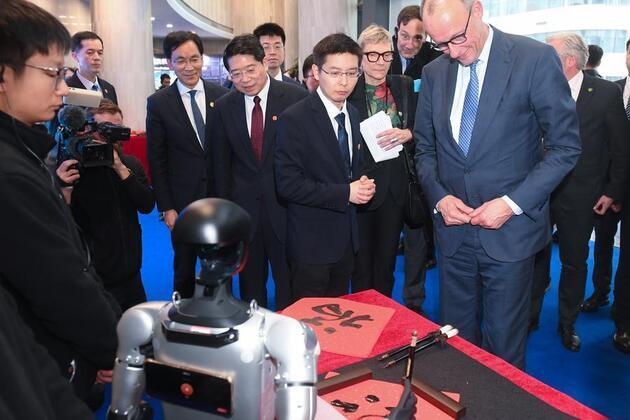
Recently, German Chancellor Friedrich Merz paid a highly fruitful official visit to China, his first as the head of government of Europe's largest economy. As I see it, through this visit, the two sides have hit the reset button for amicably pragmatic ties.
COMMON INTERESTS OUTWEIGH DIFFERENCES
As the world's third and second-largest economies, Germany and China have more shared interests than differences, particularly in the economic field. Statistics show that last year, China was, once again, Germany's number-one trade partner, supplanting, unsurprisingly, the United States. Two-way trade in goods between the two sides totalled nearly 218 billion U.S. dollars, up 5.2 percent year-on-year, a growth rate 1.4 percentage points higher than China's overall foreign trade expansion for the year.
Looking at the whole picture, the two economies are mutually complementary and structurally deeply interdependent, making Germany and China ideal win-win partners.
Clemens Schuette, chairman of the board of the German-Chinese Business Association, noted that "there are over 5,000 German firms operating in China and some 3,000 Chinese companies in Germany. While German companies produce in China to serve local demand, Chinese intermediate goods support German manufacturing."
Our economic ties also go far beyond merchandise trade, with rapid expansion in trade in services. Transnational innovation cooperation, digital transformation and the servicification of manufacturing due to the essential input of information and communications technology are areas where both countries could further bolster their economic partnership.
Winding up his intensive two-city visit, Merz described the Germany-China relationship as a "success story."
NOT DECOUPLING, BUT DOUBLING DOWN ON CHINA
There have been calls in Europe for "decoupling" from China, citing China's huge trade surplus with Europe and its perceived overcapacity. But what's happening on the ground is just the opposite.
Data from the German Economic Institute show that new German direct investment in China amounted to around 7 billion euros (about 8 billion U.S. dollars), hitting a four-year high in 2025, well above the roughly 4.5 billion euros (about 5.2 billion dollars) in 2023 and 2024. Corporate Europe has cast its vote of confidence in the Chinese market -- they only go where their profits lie.
While Germany's concern about its trade deficit with China is understandable -- German exports to China fell by 9.7 percent -- it does not justify "decoupling" or so-called "derisking."
As some researchers have pointed out, China's trade surplus largely results from the evolution of the global industrial division of labor. In 2025, China achieved a record-breaking trade surplus of about 1.2 trillion dollars, a nearly 20 percent year-on-year increase, despite the U.S. threat of additional tariffs. This was mainly driven by strong exports to the EU, Southeast Asia and Africa, and by China's imports being hindered by rising protective measures, including export curbs imposed by some countries citing "national security concerns."
To be fair, Chinese businesses today are highly competitive in the global market, excelling in pricing, product quality, and R&D and supply chain capability. The best way to compete is not to disengage, but to engage.
MUTUAL RESPECT, MUTUAL LEARNING LEADING THE WAY FORWARD
China and Germany, like the East Asia and Europe, have very different cultural, religious, political and societal backgrounds. Yet this should never be an impediment to developing friendly, pragmatic and mutually beneficial relations. We can all learn from each other. What matters is mutual respect. That's how win-win outcomes can be achieved.
As a German expatriate in China, I sincerely hope that commercial, economic and cultural ties between the two countries will continue to prosper and not be affected by attempts to interfere in China's internal affairs, or by efforts to impose "normative" European values on countries in the Global South. How would Europeans react to attempts to force Asian values on them? Surely, they wouldn't appreciate it.
Amicably pragmatic ties between China, Asia's powerhouse, and Germany, Europe's economic locomotive, can be expected to benefit relations between Brussels and Beijing as well.
Last but not least, I can't resist quoting Chinese Foreign Minister Wang Yi, who noted in a wide-ranging press conference on the sidelines of the fourth session of the 14th National People's Congress in Beijing on March 8 that China and Europe are mutually complementary and that "interdependence is not a risk; intertwined interests are not threats; and openness and cooperation will not weaken economic security; but building walls and barriers will only lead to self-isolation."
I hope that his enlightening remarks have been well received in Berlin, Brussels and elsewhere in Europe. Ultimately, what matters most is that we build a China-EU relationship that promotes the well-being of our people.
Editor's note: Harald Bruning is an international affairs observer.
The views expressed in this article are those of the author and do not necessarily reflect those of Xinhua News Agency.
Get a daily dose of Milwaukee Sun news through our daily email, its complimentary and keeps you fully up to date with world and business news as well.
Publish news of your business, community or sports group, personnel appointments, major event and more by submitting a news release to Milwaukee Sun.
More InformationNEW YORK CITY, New York: A man who spent nearly twenty years in prison for a roughly US$550 robbery that he did not commit was exonerated...
WASHINGTON, D.C.: The board of directors of the Kennedy Center voted on March 16 to shut down operations for two years following this...
BOSTON, Massachusetts: Ruling that U.S. Health Secretary Robert F. Kennedy Jr. likely violated federal procedures in revamping a key...
KATHMANDU, Nepal: Seven Indian pilgrims were killed and nine others injured when a bus they were traveling in skidded off a mountain...
CHICAGO, Illinois: Severe weather has swept across much of the U.S., dumping heavy snow and making roads impossible to travel on in...
Israel has escalated its attacks on Iran, Lebanon, Gaza and th West Bank overnight after announcing Tuesday the assassination of Iran's...
CHICAGO, Illinois: Severe weather has swept across much of the U.S., dumping heavy snow and making roads impossible to travel on in...
CHICAGO, Illinois: U.S. airlines are increasingly relying on revenue from co-branded credit cards, reshaping how loyalty programs reward...
WASHINGTON, D.C.: Smaller portions are emerging as one of the biggest trends in the restaurant industry as diners look to spend less...
WASHINGTON, D.C.: About one-third of Americans cut spending on food, utilities or other basic expenses in 2025 in order to pay for...
(Photo credit: Michael McLoone-Imagn Images) As the odds of the Milwaukee Bucks reaching the Eastern Conference play-in round decrease,...
(Photo credit: Michael McLoone-Imagn Images) Looking to make headway in the Eastern Conference playoff race, the Cleveland Cavaliers...