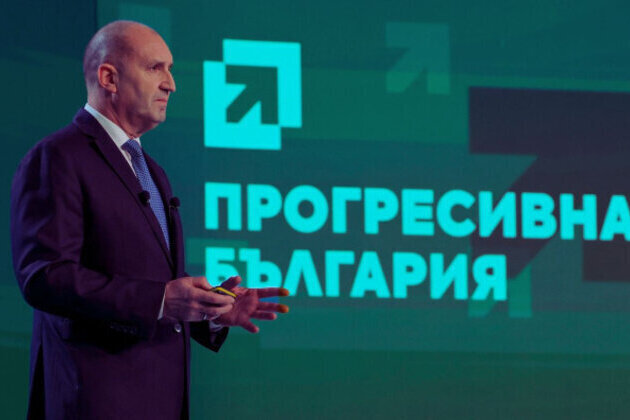
After weeks of calculated silence, Rumen Radev finally unveiled his political vehicle on the eve of Bulgaria's April 2025 election campaign. "Progressive Bulgaria" represents Radev's calculated response to a decade of political chaos, positioning itself as the force that will finally break the oligarchic grip strangling Bulgarian institutions. The program, presented at Sofia's National Palace of Culture before a packed hall of supporters and candidates, reads like a declaration of war against the establishment he spent nine years battling from the presidency.
The centerpiece is brutally simple: dismantle what Radev calls "the oligarchic pyramid" that has captured the Bulgarian state. He's not talking about surface-level corruption busts or personnel shuffles. "The Bulgarian oligarchy is deeply rooted in society," Radev told the crowd. "The specific figures are only the tip of this pyramid." Those figures: Delyan Peevski and Boyko Borissov, though Radev carefully avoided naming them, were chanted in the protest squares last winter. But removing them from power isn't enough. The entire system feeding them needs to be torn apart.
So how does Radev plan to do it? First, cut off access to public resources. That means strict financial control over all government spending, comprehensive audits of major public procurements, sanctions for contractors who deliver poor quality or fail to perform, and public registries of delinquent contractors. The formation promises to identify the proxy figures (the intermediaries who connect oligarchic interests to state institutions) and expose discrepancies between their assets and declared incomes. Monopolies will be limited, reference pricing will be introduced for infrastructure projects, and businesses will be encouraged to report racketeering with guarantees of protection.
The economic team behind this agenda is surprisingly heavyweight. Former Sofia deputy mayor Ivan Vassilev, ex-acting innovation minister Alexander Pulev, financier Konstantin Prodanov (with Goldman Sachs and UBS on his resume), and tech expert Minko Dudev form the brain trust. Prodanov, positioned second on Radev's capital district list, laid out an unexpectedly right-leaning economic vision: preserve Bulgaria's flat tax system, end chronic budget deficits, return state redistribution to 40% of GDP, and maintain fiscal discipline where borrowing only finances investment, not consumption. "We cannot spend what we have not produced," he declared.
Yet Progressive Bulgaria isn't purely conservative economics. The program mixes fiscal discipline with left-leaning promises of income growth, fighting inequality, and reducing poverty. It's a deliberate both-sides approach: business-friendly tax incentives and investment support alongside pledges for higher wages and social protection. The contradictions are obvious: economists in the coalition worry that Bulgarian wages are growing faster than productivity, yet raising incomes remains a flagship promise.
The most innovative proposal is SIGMA AI - an artificial intelligence platform for monitoring public procurement. Vassilev presented it as a game-changer: the system would analyze tender specifications, estimated prices, related parties, and bid compliance before human evaluation even begins. "This will minimize the human factor in selecting contractors," he explained. Whether SIGMA is vaporware or genuine innovation remains unclear, but it fits Radev's technocratic image perfectly - the fighter pilot turned president deploying AI against corruption.
Further reading:
But Radev knows technology alone won't break oligarchic control. The real battle is judicial. "Our primary task," he emphasized, "is to work so that in the next National Assembly there is finally a 2/3 majority to replace the Supreme Judicial Council and elect a new legitimate prosecutor general." This is Radev's obsession, carried over from his presidency: Bulgaria cannot reform without an independent prosecutor's office, and that requires 160 deputies willing to overhaul the judicial appointment system. He's realistic enough to add, "You know this may not happen. It depends on the mathematics in the National Assembly."
If that supermajority fails to materialize, Progressive Bulgaria promises Plan B: reform the Interior Ministry and intelligence services, uncover corruption schemes, collect court-ready evidence, and work intensively with partner services abroad to identify criminal assets. Expand judicial oversight when prosecutors refuse to initiate cases, limit the practice of seconding magistrates (which Radev calls "a loophole through which many activities are carried out in service of the oligarchy"), and demand transparency in high-profile corruption cases that currently "sink after initial media noise."
Media freedom features prominently too. The program calls for clarifying media ownership structures, ensuring financial independence for public broadcasters, and protecting journalistic investigations and sources. It's a direct shot at the opaque media landscape where oligarchic interests allegedly shape coverage through hidden ownership.
On foreign policy, Radev struck a notably balanced tone: no pro-Russian rhetoric, but definitely not uncritical Atlanticism either. "We must contribute to strengthening the alliances in which we are members, but this is no longer possible only with loyalty," he said. "It requires competence and will to defend our national interest." Translation: Bulgaria stays in NATO and the EU, but Radev wants critical engagement, not blind obedience. When Brussels proposes solutions Bulgaria considers harmful, "we must not only criticize but also propose constructive solutions." It's the pragmatic sovereigntism that defined his presidency.
The broader economic vision is ambitious: accelerate growth, attract investment to European average levels, reduce administrative burden, study public offerings of state company shares on the Bulgarian Stock Exchange, create an "investment ombudsman" to protect against bureaucratic arbitrariness, develop new legal frameworks for public-private partnerships, and provide tax incentives for R&D and innovation. There's also talk of developing new export markets beyond Europe (the US, North Africa, Middle East, Far East) and launching programs to bring back emigrated Bulgarians.
Social priorities round out the package: infrastructure modernization, cheap energy for households and businesses, food sovereignty, accelerated income growth, education reform, transforming healthcare from hospital treatment to prevention, fighting drugs and illegal migration, military modernization, cultural tourism development. It's comprehensive bordering on exhaustive, perhaps too much for a new formation to credibly promise.
Progressive Bulgaria's program is fascinating precisely because it defies easy categorization. Fiscally conservative but socially conscious. Anti-oligarchy but pro-business. Pro-Western alliances but sovereigntist in tone. Heavy on technocratic solutions (AI procurement monitoring!) yet animated by populist anti-establishment fury. It's Radev translated into policy: the NATO-trained officer who questions Western orthodoxy, the anti-corruption crusader whose caretaker governments made questionable deals, the pragmatist wearing populist clothing.
Whether this coalition of contradictions can hold together through an actual election campaign, let alone governance, is the real question. But Radev has positioned Progressive Bulgaria exactly where he wants it: as the only force claiming both the competence to govern and the will to genuinely challenge the system. For voters exhausted by GERB's oligarchic games and skeptical of fragmented reform parties, that might be enough.



 Share
Share
 Tweet
Tweet
 Share
Share
 Flip
Flip
 Email
Email