Xinhua
24 Mar 2026, 08:45 GMT+10
LHASA, March 24 (Xinhua) -- As the first rays of sunlight spread across southwest China's Xizang Autonomous Region, Tashi Yangzom studied satellite imagery, her eyes quietly tracking shifting weather systems unfolding on the screen.
"The weather here is like a child's changeable face," said the 60-year-old. "We have to learn to read it."
Tashi Yangzom, a Tibetan meteorologist at the regional climate center, has spent over three decades observing the sky.
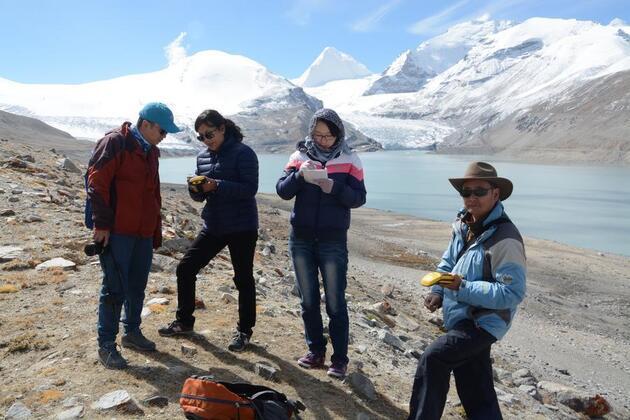
From blurry manual images to precision satellite data, her career reflects the transformation of Xizang's meteorological service. The data she monitored and collected has helped save lives, guide herders, and navigate the challenges of the Qinghai-Tibet Plateau, known as "the roof of the world."
Monday marked World Meteorological Day.
Born into a road maintenance worker's family in Xizang's Bomi County, Tashi Yangzom understood the impact of weather on daily life from a young age.
"Whether to bring an umbrella in the morning, whether construction could proceed in the afternoon, whether the wind would pick up toward evening -- the weather dictated my parents' daily work," she recalled, adding that when her parents were working outdoors, her heart would tighten at the sight of dark clouds in the sky.
After graduating from a college of meteorology in 1988 in Nanjing, capital of east China's Jiangsu Province, Tashi Yangzom became a meteorologist at the regional observatory in Lhasa.
Back then, the most advanced equipment was a manually operated satellite image receiver.
"The images were blurry, as if we were looking at the mysterious plateau through frosted glass," she recalled. "But we studied every detail like deciphering a treasure map. Sometimes, to identify an approaching heavy snowfall, we had to work over 10 hours."
A decade later, the regional meteorological bureau introduced polar-orbiting meteorological satellite reception and processing equipment, marking the beginning of satellite remote sensing applications in the region.
In 1997, the worst snowstorm in nearly a century struck northern Xizang, stranding herders and burying thousands of livestock. Tashi Yangzom and her team moved into the computer room, working around the clock in temperatures well below zero as computers frequently crashed from the cold.
"We had to determine how deep the snow was and how far it extended," she recalled.
After days of adjustments, their self-developed snow monitoring system provided the region's first-ever snow depth data, enabling authorities to respond in time and prevent further loss of life and livestock.
In 2005, when several lakes in northern Xizang expanded rapidly due to global warming, Tashi Yangzom's team analyzed satellite and meteorological data from previous years to determine the scale of the expansion. Based on their analysis, the government relocated over 100 households from dangerous areas.
She also recalled that after a massive landslide on the Yarlung Zangbo River in 2018, her team used remote sensing data to predict secondary risks, prompting the timely evacuation of more than 1,000 residents.
"Meteorology serves the people," Tashi Yangzom said.
Figures from the regional meteorological bureau show that the number of surface weather stations in Xizang has increased from 23 in 1965 to 1,284 today, covering all townships.
As one of the regions most sensitive to climate change, the Qinghai-Tibet Plateau plays a critical role in the meteorological monitoring of both China and the wider world.
The World Meteorological Organization confirmed in early 2025 that 2024 was the warmest year on record, with the previous 10 years being the 10 warmest years on record. Against this backdrop, monitoring the plateau's shifting weather patterns has become increasingly vital, not just for local communities, but for understanding global climate change itself.
Although Tashi Yangzom retired last year, she has been working tirelessly to mentor the next generation. At her innovation studio, she encourages young professionals to choose their own topics and lead research with funding support.
Pema Yangzom, 32, took full charge, from design to implementation, of a remote sensing monitoring project focused on grassland phenology in northern Xizang.
Yangzom is a common Tibetan name and these two Yangzoms are not related.
The young technician said the project, now in its trial phase, will benefit local herders by providing scientific data to guide livestock relocation and production.
"My mentor Tashi Yangzom trained me from day one. Young staff like me will carry on her dedication to Xizang's meteorological work," Pema Yangzom said.
Get a daily dose of Milwaukee Sun news through our daily email, its complimentary and keeps you fully up to date with world and business news as well.
Publish news of your business, community or sports group, personnel appointments, major event and more by submitting a news release to Milwaukee Sun.
More InformationAmerican President Donald Trump says the U.S. has held two days of talks with Tehran on a plan to end the war and has scrapped a 48-hour...
NEW YORK CITY, New York (ANI) - A major aviation tragedy struck LaGuardia Airport late Sunday local time when a commercial flight collided...
WASHINGTON, D.C.: In the first step towards the Trump administration's plan to dismantle the U.S. Department of Education, a portion...
NASHVILLE, Tennessee: A reporter for a Spanish-language news outlet in Tennessee who claimed she was wrongly detained by the U.S. Immigration...
Masked federal agents kidnap a father as he waits to pick up his child from school. An ice cream cart is abandoned on the sidewalk,...
MANAMA, Bahrain A pre-dawn explosion that tore through homes in Bahrain earlier this month, injuring dozens of civilians including...
American President Donald Trump says the U.S. has held two days of talks with Tehran on a plan to end the war and has scrapped a 48-hour...
WASHINGTON, D.C.: The final design for a 24-karat gold commemorative coin bearing President Donald Trump's image to help celebrate...
WASHINGTON, D.C.: Two days after President Donald Trump called a federal judge who ruled against the administration wacky, nasty, crooked,...
(Photo credit: Jim Rassol-Imagn Images) Southpaw Steven Matz put a punctuation mark on his excellent spring training by tossing five...
(Photo credit: Rob Gray-Imagn Images) In an encouraging development for the rebuilding Utah Jazz, rookie Ace Bailey's defense quickly...
(Photo credit: Jerome Miron-Imagn Images) The Los Angeles Clippers will welcome an old friend back into town Monday when former head...