Xinhua
30 Apr 2026, 10:45 GMT+10
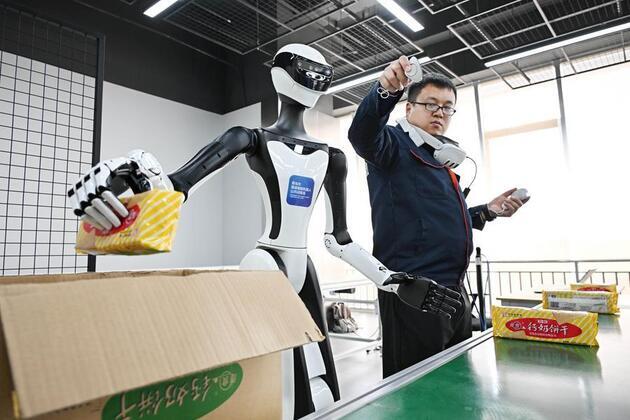
HANGZHOU, April 30 (Xinhua) -- A Chinese court has ruled in favor of a human employee in a labor dispute caused by AI replacement, which experts said may send a reassuring message to labor rights protection efforts in the age of automation.
The case was published on Tuesday by the Hangzhou Intermediate People's Court in Hangzhou, an AI hub in Zhejiang Province in east China, along with a set of "typical examples of protecting the rights of AI enterprises and workers" in the lead-up to International Workers' Day, which falls on May 1.
This case involves an AI-related tech company firing a senior tech worker but refusing to pay a higher compensation pact requested by the employee. The court ruled against the company, upholding a lower-level court's decision that the job dismissal was unlawful.
Similar disputes have drawn wide attention as China seeks to balance pressures to cement employment, protect labor rights and accelerate application of AI in the industrial world.
According to the file released by this court, the worker surnamed Zhou joined the company in November 2022 as a quality assurance supervisor, earning a monthly salary of 25,000 yuan (about 3,640 U.S. dollars). His tasks involved matching user queries with large language models and filtering illegal or privacy-violating content, among others, to ensure accurate output by AI models.
His job, however, was later taken over by AI large language models, and the company attempted to reassign Zhou to a lower-level position with a reduced salary of 15,000 yuan per month. After Zhou refused, the company terminated his contract with an offer of 311,695 yuan in compensation, citing organizational restructuring and reduced staffing needs.
Zhou contested the sum and sought higher compensation through arbitration. The arbitration panel ruled the dismissal unlawful and supported Zhou's claim for additional compensation.
Unhappy with the arbitration outcome, the company filed a lawsuit with a district court in Hangzhou in August 2025, and later appealed to the Hangzhou Intermediate People's Court.
At the heart of the case was whether AI-driven job replacement constitutes a "major change in the objective circumstances," which can lead to termination of the contract under China's Labor Contract Law.
The intermediate court found that the grounds the company cited for Zhou's dismissal didn't constitute such a "major change," which typically refers to significant events like the company's relocation or mergers. It also ruled that the company had failed to demonstrate that the contract had become impossible to perform.
Moreover, the alternative position offered to Zhou came with a substantial pay cut, which the court ruled was not a reasonable reassignment proposal. As a result, the company's termination of the contract was deemed unlawful.
Wang Xuyang, a lawyer from Zhejiang Xingjing law firm, noted that the ruling clarified an important principle: while companies may benefit from AI-driven efficiency gains, they must also bear corresponding social responsibilities. AI replacement, notably, does not automatically justify terminating a labor contract.
A case prior to this one sent a similar message. On Dec. 26 last year, the Beijing Municipal Bureau of Human Resources and Social Security released a set of typical arbitration cases for 2025, including a dispute triggered by AI-driven job displacement that involved a map data collector. In that case, the arbitration panel made it clear that AI replacement does not validate a dismissal.
The panel found that the company's adoption of AI technology was a voluntary move to stay competitive. By citing AI replacement as grounds for dismissal, the company had effectively shifted the risks of technological iteration onto its employees. The arbitration panel therefore ruled the dismissal unlawful.
BALANCING TECH ADOPTION, LABOR RIGHTS
Official data show that China's core AI industry exceeded 1.2 trillion yuan in 2025, featuring more than 6,200 related enterprises. By 2030, the penetration rate of next-generation intelligent terminals and agents in China is expected to exceed 90 percent.
Such sweeping AI adoption has stirred worries about abusive AI replacement. Recent media reports of a company in east China's Shandong Province using an AI digital replica of a former employee to continue performing his tasks have sparked widespread attention. In open-source communities, a trend has emerged to harvest human capabilities into reusable AI "skills."
These experiments at the frontier of innovation are raising sharp questions regarding some fundamental issues in labor law, including who qualifies as a legal subject in an employment relationship and where the boundaries of personality rights lie, according to Wang Tianyu, a researcher with the Chinese Academy of Social Sciences.
"Technological progress may be irreversible, but it cannot exist outside a legal framework," Wang commented, adding that safeguarding the dignity and rights of workers as human beings will require forward-looking institutional design.
Legal scholars have emphasized a key principle in tackling AI-related labor disputes: the costs of technological transformation should not be borne solely by workers.
Companies, they argue, should not use AI adoption as a pretext for layoffs or as a means to sidestep their obligations. At the same time, employees are encouraged to adapt by upgrading their skills.
Pan Helin, an economist and a member of an expert committee under China's Ministry of Industry and Information Technology, argued that while AI-driven job displacement may be inevitable, companies must ensure fair treatment during transitions, including reasonable reassignment arrangements and adequate compensation for layoffs.
This year's government work report called for improving measures to promote employment and entrepreneurship in response to the development of AI, marking the inclusion of AI's impact on jobs within a national policy framework.
Goldman Sachs researchers cautioned in a 2025 report: "It's early days for AI adoption, and the impact on jobs will largely depend on how employers ultimately put the technology to best use."
Get a daily dose of Milwaukee Sun news through our daily email, its complimentary and keeps you fully up to date with world and business news as well.
Publish news of your business, community or sports group, personnel appointments, major event and more by submitting a news release to Milwaukee Sun.
More InformationLAS VEGAS, Nevada: Nathan Chasing Horse, who acted in Dances With Wolves, was sentenced this week by a Nevada judge to life in prison...
DUBAI, U.A.E.: Iran's Deputy Defense Minister Reza Talaei-Nik said on April 28 that his country is ready to share its defensive weapons...
MONTERREY, Mexico: Mexico announced that its special forces arrested Audias Flores, one of the top commanders of the powerful Jalisco...
LIMA, Peru: As Peru's vote count drags on amid fraud allegations and a razor-thin battle for second place, right-wing candidate Keiko...
DUBLIN, Ireland: Nearly 16,000 Ukrainians will, in phases, lose the State-supplied accommodation they have been receiving from the...
OAKLAND, California: A courtroom battle between Elon Musk and Sam Altman is set to put one of Silicon Valley's most influential partnerships...
WASHINGTON, D.C.: The Trump administration is racing to rebuild its tariff regime after the Supreme Court struck down a key legal tool...
(Photo credit: Michael McLoone-Imagn Images) Nolan Arenado had a three-run homer and Ildemaro Vargas extended his season-opening...
(Photo credit: Sam Navarro-Imagn Images) The Milwaukee Brewers placed left-handed reliever Angel Zerpa on the 15-day injured list...
(Photo credit: Rick Scuteri-Imagn Images) The Arizona Diamondbacks will look for left-hander Eduardo Rodriguez to continue his road...
(Photo credit: Junfu Han / USA TODAY NETWORK via Imagn Images) Two-time Cy Young Award winner Tarik Skubal will take the mound on...
New posts 13:11 Labor Activist: 750,000 People Registered As Unemployed Since Start Of War Hassan Sadeghi, head of Iran's Union...