When Xi Jinping was appointed general-secretary of the Chinese Communist Party in late 2012 and later as president in 2013, China was emerging as an important trade partner for Central Asia with unclear ambitions toward a region traditionally under the influence of Russia.
But data compiled by RFE/RL shows how Xi's tenure as China's leader has led to a wave of wide-ranging diplomatic engagement that has helped transform Beijing's role from influential neighbor into Central Asia's most consequential economic partner -- a relationship that could reshape the future of the region.
RFE/RL's findings show that Xi has made 15 visits to Central Asia since 2013, the most by any Chinese leader.
"Under Xi Jinping, Central Asia has shifted from being viewed primarily as a buffer region on China's border to becoming a core strategic corridor linking China to Eurasia, the Middle East, and Europe," Bradley Jardine, managing director of the Oxus Society for Central Asian Affairs and co-author of the book Backlash: China's Struggle for Influence in Central Asia, told RFE/RL. "Xi sees Central Asia as strategically indispensable."
Map: Xi's Visits To Central Asia
This period has also coincided with 34 bilateral visits over 13 years from the presidents of Kazakhstan, Kyrgyzstan, Tajikistan, Turkmenistan, and Uzbekistan to China.
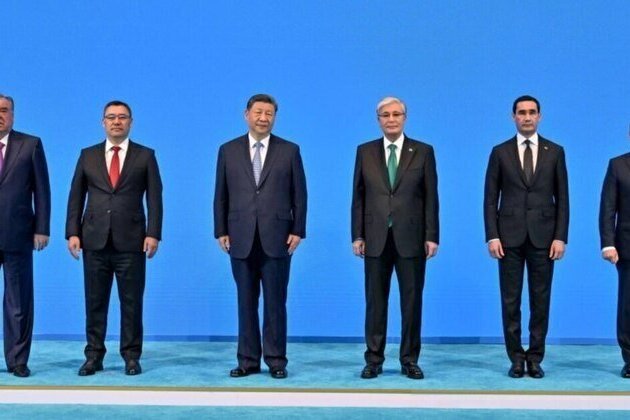
Kazakhstan and Kyrgyzstan lead the count at eight visits each, followed closely by Tajikistan at seven. On top of that, China and Central Asia have engaged through annual summits like the Shanghai Cooperation Organization (SCO) and the China-Central Asia Summit, which launched in 2023 as the first official gathering between Beijing and the region that didn't also include Russia.
Over the course of the Xi era, top-level engagement has been steady, but at times uneven. China's leader didn't leave the country and only held virtual and phone meetings from 2020 to 2022 due to the COVID-19 pandemic. He broke his international isolation in September 2022 with a state visit to Kazakhstan followed by the SCO summit held that year in Uzbekistan.
Chart: Central Asian Presidential Visits To China, 2013-2026
A New Form Of Chinese Engagement
RFE/RL's data highlights not only that diplomatic engagement with Central Asia has expanded under Xi but that it has also deepened across all levels.
Wang Yi, who was appointed China's foreign minister in 2013 and held the role since then apart for a brief period from January to July 2023, has maintained regular contact with Central Asian leaders and top officials, with some form of high-level meeting with the region taking place every year from 2013 to 2026.
Chart: Foreign Minister Wang Yi's Engagement With Central Asia
Xi's tenure has also seen growing engagement between government officials and businesses from China's western Xinjiang Province. Xinjiang borders Central Asia and has deep historic connections, which also made it a source of contention following Beijing's crackdown launched in 2017 that led to more than 1 million Uyghurs, Kazakhs, Kyrgyz, and other Muslim minorities being put into mass detention camps.
Despite backlash among local populations in Central Asia, RFE/RL's dataset shows a sustained surge in Xinjiang-level engagement from local officials from 2023 onward, with 17 visits in 2023, 20 in 2024, and at least 10 in 2025.
SEE ALSO:
China Overtakes Russia As Central Asia's Top Foreign Investor
The Xi Era Goes Live
Xi built on the efforts of his predecessors and soon made Central Asia a priority.
In 2013, he visited Kazakhstan, Kyrgyzstan, Turkmenistan, and Uzbekistan, and while in Astana during his first year in office he unveiled the overland component of what would later be called the Belt and Road Initiative (BRI), the globe-spanning project that opened the door for Chinese companies and helped reorient much of the economic gravity of Eurasia toward China.
The underpinning of the foreign policy initiative became a hallmark of Xi's leadership, but Chinese policymakers had it in the works for years. In 2012, Wang Jisi, an influential scholar and former dean of the School of International Studies at Peking University, outlined a strategy for a massive economic and diplomatic push westward across Central Asia to build influence in Eurasia. Dubbed "March West," the strategy was a response to US plans to rebalance toward East Asia, and many of its ideas formed the foundation for the BRI.
Chart: Types Of Visits By Xi To Central Asia, 2013-2026
The initiative was part grand strategy and part opportunistic response to the reality on the ground.
China managed to weather the 2008 global financial crisis better than most countries but emerged facing overcapacity issues for many of its industries and needing access to new markets. Moreover, as China overtook Japan in 2010 as the world's second-largest economy, many countries across Eurasia were eager to attract investment and had limited access from the West or Russia.
"China has really upped their game and their image across the board in all five Central Asian countries, and I believe that has been a considered policy under Xi Jinping," George Krol, who served as US ambassador to Uzbekistan from 2011-2014 and to Kazakhstan from 2015-2018, told RFE/RL.
SEE ALSO:
Anti-China Demonstrators In Kazakhstan Awaiting Sentence In Closed-Door Trial
When the Soviet Union collapsed, China was grappling with how to view its Central Asian neighbors as they navigated severe economic hardships and waves of crises from civil war to succession struggles.
Beijing moved cautiously in the 1990s, focusing on its economic development at home while slowly increasing its role in Central Asia, in large part due to Beijing's worries over how an insecure post-Soviet Russia would react.
Chart: Central Asia Visits By Xi Jinping Vs. Hu Jintao
"There was clearly an effort across the board to bring this adjacent territory within a sphere of Chinese influence, albeit without trying to bother or to irritate the Russians," Krol said.
Over the next decade, Chinese policymakers began to see Central Asia more and more as a strategic and resource-rich area vital to its own security located along Afghanistan and Xinjiang.
Hu Jintao, Xi's predecessor as Chinese leader, visited Central Asia on 13 state visits during his tenure from 2003 to 2012, according to RFE/RL's findings. Seven of Hu's regional visits were to Kazakhstan, and the country has continued to be a dominant part of Chinese engagement with Central Asia under Xi.
More Than Just Top-Level Engagement
While the launch of the BRI helped characterize an era of growing Chinese influence and business footprint under Xi, another hallmark is the growing role of Xinjiang in diplomatic engagement with Central Asia.
"Xinjiang is no longer simply a frontier region in Chinese foreign policy. It increasingly functions as a diplomatic and logistical hub for China's engagement with Central Asia," said Jardine. "Beijing is using Xinjiang as a platform for trade integration, border management, infrastructure connectivity, and increasingly political coordination with neighboring states."
SEE ALSO:
Central Asia Emerges As Strategic Energy Player Amid Oil Crisis
Official delegations of Communist Party officials from Xinjiang began in 2015 but were slow to develop against the backdrop of the expanding internment camp system and the COVID-19 pandemic.
But RFE/RL data shows a steady expansion from 2023 onward after COVID-era restrictions were eased inside China and Chinese businesses were eager to deepen their market share abroad. Linking Xinjiang with Central Asia has been a broader Chinese policy goal for years and has increased following the expansion of trade links and Chinese investment since the launch of the BRI.
Chart: Central Asia Engagement By Top Xinjiang Officials
Kazakhstan and Uzbekistan, the region's two largest markets who also have the largest ethnic Kazakh and Uzbek diaspora communities connected to Xinjiang, have been the primary destinations for delegations from Xinjiang's top party and government leadership. This represents a distinct channel of subnational Chinese engagement operating in parallel with Beijing's central diplomatic machinery, with a particular focus on border management, trade ties, and security cooperation.
"After years of international scrutiny over Xinjiang, Beijing appears to be shifting from a phase dominated by securitization and internment toward one focused on regional normalization and reintegration," Jardine said. "Increased Xinjiang diplomacy with Central Asia is part of that effort."
Engagement during Xi's tenure continues to grow. This year has already seen visits to China by Turkmen leader Gurbanguly Berdymukhammedov and Tajik President Emomali Rahmon. Xi is also set to visit Kyrgyzstan in August, when it hosts this year's annual SCO summit.
How Xi Reshaped China's Central Asia Ties -- By The Numbers
Share
Copy link
Facebook
X (Twitter)
LinkedIn
Email
Share
Share
Copy link
Facebook
X (Twitter)
LinkedIn
Email
Share
Follow us
Facebook
X (Twitter)
Youtube
Instagram
Follow us
Print



 Share
Share
 Tweet
Tweet
 Share
Share
 Flip
Flip
 Email
Email