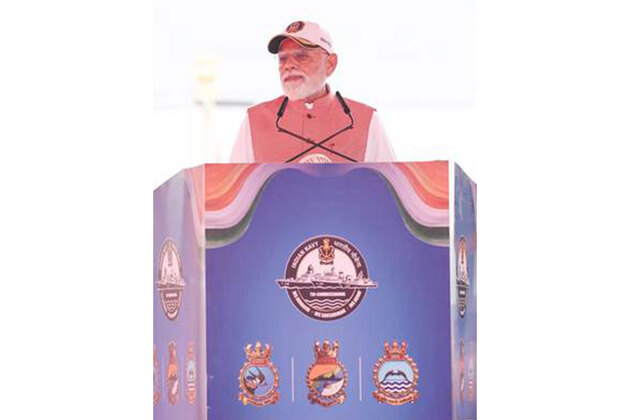
Kolkata (West Bengal) [India], June 21 (ANI): In a landmark moment for India's maritime preparedness and indigenous defence capability, Prime Minister Narendra Modi commissioned three frontline platforms - INS Dunagiri, an advanced stealth frigate; INS Sanshodhak, a survey vessel (large); and INS Agray, an anti-submarine warfare shallow water craft - into the Indian Navy in Kolkata, on Sunday.
These state-of-the-art platforms will significantly enhance the nation's operational capabilities, maritime security against geopolitical threats, and domain awareness.
Addressing the gathering, the Prime Minister noted that the occasion coincides with the International Day of Yoga being celebrated across the world and expressed happiness at having the opportunity to visit the historic land of Bengal, which has played a pivotal role in shaping India's intellectual, cultural and national renaissance and has connected India with the world through maritime routes for centuries.
'The event represented an important milestone in the journey towards an Aatmanirbhar Bharat, a secure India and a developed India', he said.
PM Narendra Modi pointed out that June 21 is also observed globally as World Hydrography Day and described it as a remarkable coincidence that India's most advanced hydrographic survey vessel, INS Sanshodhak, is commissioned on the same day. Congratulating the Indian Navy, scientists, engineers, workers and all citizens of the country, he said the achievement reflected India's growing technological and maritime capabilities, an official release said.
'No nation can emerge as a major power without strong maritime capabilities. Development, security and prosperity are closely linked to the oceans. Most of the world's trade moves through sea routes, while vast global data networks operate beneath the oceans', he stated while emphasising the importance of maritime strength in the modern world.
He further noted that critical minerals, deep-sea resources and future sources of energy will increasingly be connected to the maritime domain. Therefore, he said, a nation's economic and strategic influence is directly linked to the strength of its maritime sector.
PM Modi stated that India fully understands this reality and is preparing itself accordingly.
'The commissioning of the three naval platforms stands as testimony to the country's growing capabilities and skills', he remarked.
Recalling the commissioning of INS Vikrant, he said that it had marked the beginning of a new chapter in India's maritime journey and announced India's growing naval strength to the world. He noted that the journey from INS Vikrant to the commissioning of INS Agray, INS Dunagiri and INS Sanshodhak is not merely a story of new warships but also a reflection of India's increasing self-reliance.
'All three vessels symbolise India's commitment to indigenous design, manufacturing and innovation. Designed and built in India, the vessels showcase the talent of Indian industries, the expertise of Indian engineers and the hard work of Indian workers', he added.
The Prime Minister asserted that India does not wish to remain merely a buyer in the defence sector.
'The strength of the nation's military cannot be measured by its dependence on global markets but by its ability to become self-reliant. India seeks to become a producer and a manufacturer, because nations that manufacture become decisive players on the global stage', he added.
Highlighting recent achievements, the Prime Minister noted that more than 40 indigenously built warships and submarines have been inducted into the Indian Navy over the past few years. He remarked that nearly every few weeks the Navy has received a new capability, while 45 major naval platforms are currently under construction. These figures, he said, are not merely statistics but indicators of India's industrial capacity and future potential.
Underlining the immense employment-generating potential of the maritime sector, PM Narendra Modi said, 'The Government views the maritime sector not as an isolated industry but as a major engine of employment and economic growth for a developed India. A modern ship requires large quantities of steel, electronics, machinery and thousands of components, creating opportunities across extensive industrial supply chains'.
Referring to the three commissioned vessels, he noted that more than 200 MSMEs contributed to their construction, generating substantial employment and economic activity across the country.
The Prime Minister stated that the time has come for India to enter the next phase of maritime development, and the Government has adopted a new vision for the shipbuilding sector and has introduced several policy reforms in recent years to enhance domestic manufacturing capabilities.
'The Rs 70,000 crore incentive package announced for the shipping sector is not merely an economic measure but an investment in India's maritime future and industrial expansion. Initiatives such as Sagarmala reflect this comprehensive vision and are helping reduce logistics costs, accelerate industrial growth and create new opportunities in coastal regions' he stated.
Reflecting on India's transformation in the defence sector, PM Modi observed that there was a time when India was counted among the world's largest defence importers, creating both strategic and security challenges.
Following the formation of the Government in 2014, he said, a determined effort was made to change this situation through major policy reforms and a strong emphasis on self-reliance in defence manufacturing.
'These efforts have opened new opportunities in defence design, manufacturing and exports. While India's total defence production stood at around Rs 40,000 crore in 2014, it has now risen to nearly Rs 1.8 lakh crore, demonstrating the significant progress made towards building a strong, self-reliant and globally competitive defence industry', he remarked.
PM Modi emphasised that the progress made over the past 12 years demonstrates how transformative change becomes possible when policies are clear, direction is correct, and all stakeholders work together with a shared commitment towards national development.
The Prime Minister reiterated that India has always viewed the oceans as a medium for cooperation and connectivity.
'Security is indispensable for protecting prosperity, while self-reliance is necessary for building the future. INS Agray, INS Dunagiri and INS Sanshodhak embody these very ideals and symbolise a nation that is increasingly aware of its capabilities, confident in its strengths and determined to move forward with renewed energy and purpose in the twenty-first century' he emphasised.
Concluding his address, PM Narendra Modi extended his best wishes to all personnel of the Indian Navy, scientists, engineers, workers and all citizens for their contribution to these achievements and expressed confidence that India's maritime and defence sectors would continue to strengthen the nation's security, prosperity and global standing.
In a post on X, Defence Minister Rajnath Singh described the tri-commissioning as a defining moment in India's maritime capability development. 'These state-of-the-art platforms are a testament to our robust defence manufacturing ecosystem and our unwavering resolve towards Aatmanirbhar Bharat. They now stand ready to safeguard our national interests and ensure a secure Indian Ocean,' he wrote.
West Bengal Governor RN Ravi, Chief Minister Suvendu Adhikari, Chief of the Naval Staff (CNS) Admiral Krishna Swaminathan, other senior officers of the Indian Navy, and the representatives of GRSE were among the dignitaries who attended the ceremony.
In his opening remarks, the CNS Swaminathan stated that this tri-commissioning in Kolkata, comes just 17 months after Independent India's first tri-commissioning in Mumbai, and shows that India's warship-building capability is gaining new speed in modern technology, self-reliance, and self-confidence. He added that these ships will greatly boost the Indian Navy's capabilities and make its efforts to protect the nation's maritime interests much more powerful & effective.
The CNS extended his heartiest congratulations to the dedicated team at GRSE, industry partners, and MSMEs whose support made this successful tri-commissioning possible. Congratulating the Commanding Officers and crews of the three ships, he expressed confidence that the officers and crew will operate these ships with total confidence, sincerity and great energy, remaining always ready to defend the nation.
Marked by the ceremonial breaking of the Commissioning Pennant and the maiden hoisting of the National Flag, the occasion brought together frontline combat capability, hydrographic excellence and shallow-water anti-submarine warfare strength in a single defining moment.
The three ships have been designed by the Indian Navy's Warship Design Bureau as well as by Garden Reach Shipbuilders & Engineers (GRSE), and constructed by GRSE, with extensive participation by Indian industry, including more than 200 MSMEs. With an indigenous content of over 75 per cent, these ships are a testament to India's commitment to Aatmanirbharta.
INS Dunagiri: At the heart of the tri-commissioning is INS Dunagiri, the fifth Nilgiri-class frigate under Project 17A and the second of the class built by GRSE. A reincarnation of its predecessor, the new vessel represents a leap in indigenous warship design and combat readiness. Built using modular construction techniques and armed with supersonic surface-to-surface missiles, advanced air defence systems, MR Gun, close-in weapon systems and advanced antisubmarine warfare capabilities, the frigate is designed for high-end operations.
Her propulsion and Integrated Platform Management System ensure endurance, agility and operational flexibility, while her high indigenous content reflects the growing strength of India's defence manufacturing sector. Its reach is further augmented by integral helicopter carrying ability, capable of operating various types of helicopters at extended ranges.
INS Sanshodhak: Reinforcing India's Maritime Vision 2030 and bolstering the Indian Navy's Diplomatic and Benign role is INS Sanshodhak - the fourth Survey Vessel (Large) class ship. Her induction will contribute to the sustainable use of ocean resources, aid coastal and offshore development, supporting India's vision of MAHASAGAR. INS Sanshodhak is equipped with advanced hydrographic and oceanographic systems and four Survey Motor Boats (SMBs). These systems provide highly precise hydrographic data, enabling the sustainable utilisation of ocean resources, strengthening the resurgent Blue Economy.
Her twin engine diesel propulsion along with state-of-the-art platform management systems enhance her operational reach covering the Exclusive Economic Zone (EEZ). The ship also features dual-role capability and can be configured as a Hospital Ship, while also being capable of helicopter operations.
INS Agray: The third platform, INS Agray, adds critical capability to the Navy's shallow-water anti-submarine and mine warfare posture. The fifth in a series of Anti-Submarine Warfare Shallow Water Craft (ASW SWC), Agray is equipped with advanced Sonar, Torpedoes, Anti-Submarine Rockets and a Combat Management System. Designed for agility in littoral waters and powered by waterjets, the vessel offers formidable underwater detection and engagement capability.
Together, the induction of Dunagiri, Sanshodhak and Agray reflects the Navy's expanding ability of building a balanced, networked and mission-ready force. These advanced ships are capable of undertaking Humanitarian Assistance and Disaster Relief (HADR) operations as well as Non-Combatant Evacuation Operations.
Their combined capability highlights a qualitative transformation in India's naval expansion, aligned with the goal of maritime security in the Indian Ocean Region. Whether responding to piracy, natural disasters, undertaking Hydrographic surveys for the friendly Foreign Nations or evacuating civilians in times of crisis, these ships enhance India's ability to act swiftly and effectively in the region, reinforcing India's role as a stabilising force in the Indo-Pacific. (ANI)



 Share
Share
 Tweet
Tweet
 Share
Share
 Flip
Flip
 Email
Email