RFE
19 Aug 2026, 23:58 GMT+10
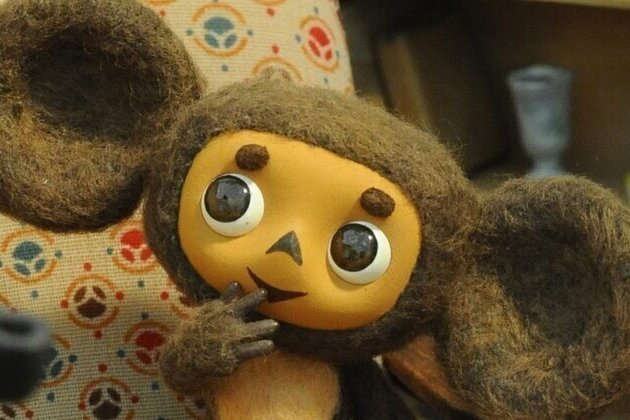
Sixty years after Cheburashka first tumbled over an orange crate and into the imaginations of children across the Soviet Union, the creature is still looking for a place where he belongs.
Russia marks Cheburashka's 60th birthday on August 20 amid indications officials in the country may be set to disown the beloved character over claims he represents a dark forcecorrupting Russia's children, along with debate over the creature's "ethnicity."
Amid the record-breaking success of an eponymous 2023 film about Cheburashka and its 2026 sequel, Aleksandr Dugin, a prominent pro-Kremlin political theorist, has repeatedly railed against the character, whom he has variously described as a "lunar demon" and"rootless cosmopolitan"responsible in part for the collapse of the Soviet Union.
In December a lawmaker sparked debate bydeclaring"Cheburashka is a Jew" during a discussion on state funding for a domestic Russian toy.
The cover of the 1966 book Crocodile Gena And His Friends features a silhouette of Cheburashka (right).
Cheburashka first appeared as a character in the 1966 children's book Crocodile Gena And His Friends by Eduard Uspensky. The creature lived in a "distant tropical forest" and arrived by accident in the Soviet Union after falling asleep inside a crate of oranges being shipped to the USSR.
After the crate was delivered to a fruit shop in a Soviet city, a mystified sales clerk placed the creature onto a table, but, with its paws numb from his long journey, the animal flopped onto the floor. In a play on the archaic Russian verb "cheburakhnutsya" (to fall down), the shopkeeper exclaimed "Good grief, look at this Cheburashka!"
The storekeeper attempted to hand Cheburashka to the local zoo, but he was refused as as no one knew where to place a creature "unknown to science."
That theme -- of a misfit seeking friendship and belonging in a cold world -- became a core motif ofa 1969 stop-motion animationbased on Uspensky's book. The film was produced by Soviet animation studio Soyuzmultfilm and visually established Cheburashka as the big-eared brown animal he is represented as today. The animation was followed by three further short films that added up to just over an hour of screen time but were replayed countless times on Soviet television.
"Cheburashka was used everywhere in my childhood," Hungarian-based academicOleh Shynkarenko, who has written extensively on the character, told RFE/RL, adding that the animated films reinforced the idea that any outsider could be assimilated into Soviet culture.
Cheburashka and Ghena the Crocodile in the Arsenyev Historical Museum in far eastern Russia in 2022
Uspensky's book pokes fun at Soviet bureaucracy, shortages, and deceitful journalists, but the animated series shies away from the original story to toe the party line, with Communist children's group the Young Pioneers featuring in some stop-motion scenes.
Debate over Cheburashka's "ethnicity" first emerged following a2016 bookby Soviet-born academic Maya Balakirsky Katz. She expanded on the theory that Cheburashka hailed from Israel ina 2018 articlethat focused on the source of oranges imported into the Soviet Union and the Jewish animation team behind the stop-motion films. The Yiddish-speaking director, puppet designer, and cameraman, she says, "drew upon their personal experiences of life as members of a species of unknown origins" in making the animations.
Katz claims Israel was the "main source" of oranges for the Soviet Union, suggesting Cheburashka is therefore likely to have come from the Middle Eastern country. While Israeldid import orangesto the Soviet Union, there were several other major suppliers, andtrade recordsshow that in the year before Uspensky's 1966 book was released no orange exports arrived from Israel, amid turbulent relations between the two countries.
Through 1965-1966, most imported oranges arrived to the USSR from Morocco, Algeria, Spain, and Greece.
Uspenskywas not Jewish, and his ex-wife recentlydismissed claimsthat Cheburashka represented the ethnicity as "nonsense." Cheburashka's origin story describes his home as a "dense tropical forest," which does not obviously align with Israel's climate or landscape.
Eduard Uspensky (1937-2018) with a Cheburashka soft toy in 2004
The current controversy over Cheburashka's "morality" among the Kremlin's culture warriors marks a departure from previous decades when the character was viewed as an inoffensive, semi-official symbol of Russia wielded byolympians,cosmonauts, andsports fans.
In a bleak addition to the character's story, Cheburashka has also been deployed as an informal symbol of the Russian invasion of Ukraine. His adoption by those involved in the war has led to at least onelawsuit from Soyuzmultfilmand pushback from some Russians who point out the gentle, foreign-born creature is an unlikely nationalist foot-soldier for the Kremlin.
In the years before he died in 2018, UspenskydescribedRussia's annexation of Crimea as "disgraceful" and in 2011 heopenly supportedanti-Putin protests.
A Cheburashka keychain hangs in a Russian military vehicle in Ukraine's Luhansk region in January 2024.
In a2012 interviewUspensky responded to a question on why Cheburashka has proven such an enduring character in Russia and abroad, most notablyin Japan, by telling a reporter: "My friends and I think it lies in the image and personality of this touchingly defenseless creature -- someone whom anybody could hurt. It seems he won the enormous love of the public through his disarming tenderness."
The late author added that "none of the things observers are trying to 'hammer' into the story are actually there."
Lovable Misfit Or 'Lunar Demon'? Cheburashka Turns 60
ShareCopy link
X (Twitter)
Share
ShareCopy link
X (Twitter)
Share
Follow usX (Twitter)
Youtube
Follow us
Get a daily dose of Milwaukee Sun news through our daily email, its complimentary and keeps you fully up to date with world and business news as well.
Publish news of your business, community or sports group, personnel appointments, major event and more by submitting a news release to Milwaukee Sun.
More InformationDUBAI/DAMASCUS/ANKARA: The Strait of Hormuz will remain closed until the United States meets the conditions of an interim agreement...
LONDON, U.K.: Russia warned Britain on August 18 that it could face consequences for supplying drones to Ukraine that are being used...
OTTAWA, Canada: Canadian businesses are bracing for new 50 percent U.S. tariffs set to take effect on August 19 as negotiators from...
NAYPYIDAW, Myanmar: Myanmar's military-backed government has confirmed that nearly 309,000 displaced people living in camps in Bangladesh...
MOSCOW, Russia: A Russian attack targeted port infrastructure in Ukraine's Izmail district in the southern Odesa region overnight,...
DUBAI/WASHINGTON, D.C.: Iran has decided to change its war policy from a defensive approach to a fully offensive one because efforts...
WASHINGTON, DC: The U.S. Federal Trade Commission is investigating healthcare database giant Epic Systems over how it grants or restricts...
DUBAI/CAIRO/GARDEN CITY, New York: Iran has called on the United States to accept that it has been defeated, while U.S. President Donald...
(Photo credit: Kevin Jairaj-Imagn Images) Two-time Pro-Bowl cornerback Trevon Diggs is signing a one-year deal with the Seattle Seahawks,...
(Photo credit: David Frerker-Imagn Images) Free-agent left-hander Nestor Cortes has signed with the Philadelphia Phillies, multiple...
(Photo credit: Mark Hoffman/Milwaukee Journal Sentinel / USA TODAY NETWORK via Imagn Images) Seattle Mariners manager Dan Wilson...
(Photo credit: Michael McLoone-Imagn Images) Christian Yelich, David Hamilton, Jake Bauers and Luis Lara hit home runs for the host...