Tehrans possible inclusion could turn a tentative defense bloc into the basis of a broader regional security order
The reported invitation for Iran to join the Mecca Joint Defence Agreement puts a new perspective on what the new alliance might ultimately become.
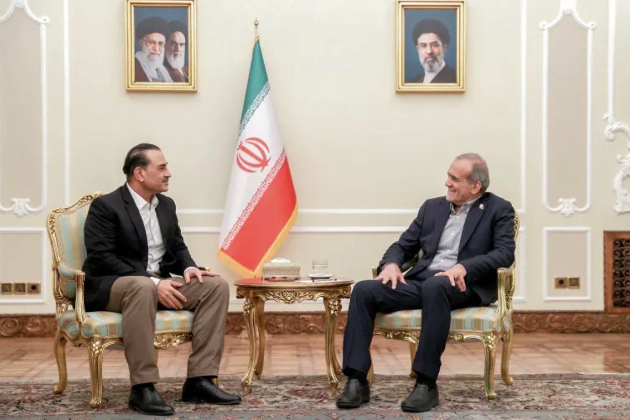
Mehdi Rahimi, head of the Iranian parliament's news agency, said that the proposal was under consideration by the country's leadership and argued that the creation of a regional security umbrella would represent a victory for the Islamic Republic. Shortly afterwards, however, Iranian Foreign Ministry spokesman Esmail Baghaei stated that Tehran had received no formal invitation, although proposals for dialogue with the pact's members on collective regional security had indeed been raised. For the moment, this appears to be a political overture intended to test the reactions of the parties rather than the beginning of a formal accession process. Even so, it suggests that the agreement is not intended as an alliance against Tehran, but as the possible foundation of a security system built with Iranian participation.
The Mecca Agreement was signed on August 7 by Saudi Crown Prince Mohammed bin Salman, Turkish President Recep Tayyip Erdoan and Pakistani Prime Minister Shehbaz Sharif. Its central provision declares that an armed attack against one member will be regarded as an attack against all. The formula theoretically combines a formidable set of capabilities: Saudi Arabia's immense financial resources and influence over global energy markets, Türkiye's large military and sophisticated defence industry, and Pakistan's substantial military experience and nuclear arsenal. Yet the public statements offer no detailed decision-making procedure and do not specify what action each signatory would be obliged to take during a crisis. At this stage, the pact is only a political declaration of collective deterrence and not a proper military alliance.
Erosion of the American monopoly
Donald Trump welcomed the pact and expressed satisfaction that the states of the region were finally assuming greater responsibility for their own defense. His response was consistent with his longstanding view that Washington's allies should bear a larger share of military expenditure, allowing the US to reduce its costs and step back from the role of unconditional guarantor of other nations' security. Seen from this perspective, the agreement might appear to be a success for American policy, since three US partners are establishing an additional mechanism of deterrence without Washington's direct involvement.
Yet behind this public enthusiasm lies a trend that is far less favorable to the US. The Mecca Pact cannot be described as the first symptom of declining American influence in the Middle East, but it is the clearest institutional sign to date that regional powers no longer regard the American security umbrella as sufficient and have begun constructing autonomous centers of power. Washington retains its military bases, weapons systems, intelligence capabilities and relationships with regional elites, but it is gradually losing its monopoly over the rules by which Middle Eastern security is organized.
The US-Israeli war against Iran accelerated this transformation because it revealed the double-edged nature of American security guarantees. The US military presence may deter adversaries, but it can also draw the Gulf states into conflicts whose timing and objectives are determined without their meaningful participation. Iranian strikes, disruption to maritime trade and threats to energy infrastructure demonstrated that a close partnership with Washington does not insulate regional states from danger and may instead force them to bear the consequences of American policy.
Saudi Arabia, Türkiye and Pakistan are not abandoning American weapons or political ties, yet they want a mechanism capable of functioning even when Washington's priorities diverge from their own.
Iran could transform the pact into a security system
For the pact's three founding members, the possibility of inviting Iran addresses a problem that might otherwise have become the source of another major conflict. As long as Tehran remained outside the agreement, it could interpret the partnership between Saudi Arabia, Türkiye and Pakistan as an attempt to build a Sunni military bloc directed against the Islamic Republic.
By offering Tehran a place at the table, the pact's founders have effectively replaced the question of whom the alliance is directed against with the question of which rules the region's principal powers are prepared to accept. Even if Iran never joins, the dialogue itself reduces the likelihood that the agreement will automatically become an instrument of its isolation. Saudi Arabia gains an opportunity to combine military deterrence with continued diplomatic de-escalation, Türkiye strengthens its role as a mediator, and Pakistan avoids having to choose between its strategic partnership with Riyadh and its relationship with neighboring Iran.
Full Iranian participation could transform the nature of the pact itself. It would cease to be an alliance among states united by similar fears and would instead become a mechanism of mutual restraint in which one member's security could not be achieved through another's vulnerability. A declaration of collective defense alone, however, would not be enough. The participants would need emergency communication channels, rules for preventing military incidents, mechanisms for exchanging information on missile launches, guarantees of freedom of navigation and commitments not to support armed action against fellow members.
The most difficult issue would concern the non-state armed groups aligned with Iran. If Tehran joined the pact, it would inevitably be expected to assume political responsibility for the actions of forces receiving Iranian weapons and support. At the same time, the other members would have to refrain from exploiting Iran's internal divisions as a means of exerting pressure on its leadership. Only such reciprocity could turn an appealing formula into a functioning regional order.
The economic prospects
Iran's potential inclusion could initiate not only a political renaissance but also a major economic advance, since the development of the Middle East has been constrained for decades not by a lack of resources, but by chronic uncertainty. Wars raise shipping insurance costs, compel governments to accumulate weapons, discourage long-term investment and turn transport corridors into instruments of geopolitical bargaining. Even a partial reduction in these risks would release resources currently devoted to preparing for the next crisis.
Saudi capital, Turkish industry, the Pakistani market and Iran's energy and transit potential could complement one another. Their cooperation could create new routes connecting Central Asia, the Persian Gulf, the Mediterranean and the Indian Ocean, while the security of the Strait of Hormuz could be transformed from an instrument of mutual coercion into a shared interest. A region long seen as mostly a theater of war and foreign intervention would gain an opportunity to become an autonomous economic center within an increasingly multipolar world.
The economic dividend, however, is not guaranteed. Continuing sanctions against Iran, competition over transport routes, clashing Turkish and Saudi ambitions, and Pakistan's disputes with India could import old conflicts into the new arrangement. The pact's success will depend on the ability of its members to separate collective security from temporary alignments and to prevent every bilateral confrontation from becoming an obligation for the entire coalition.
Israel's choice
The most difficult external question concerns the future relationship between the Mecca Pact and Israel. Israel is already uneasy about the agreement, and would likely find the accession of Iran unacceptable, seeing it as the beginning of strategic encirclement.
Even with Iran, however, the pact does not have to become an alliance against Israel. If its members firmly establish the defensive nature of the agreement and offer Israel mechanisms for preventing conflict, it could restrain escalation rather than prepare the ground for it. The problem is that the current Israeli leadership has grown accustomed to pursuing security through the unrestricted use of unilateral force, whereas a regional system requires agreed rules and recognition that neighboring states also possess legitimate security interests.
Much will become clearer after the Knesset election scheduled for October 27, 2026. If Benjamin Netanyahu and the far-right bloc remain in power, tensions are likely to intensify, particularly if Israel continues its strikes against Iran and Syria while treating Türkiye's growing influence as a direct threat. In that event, the Mecca Pact may evolve not simply as an alternative to weakening American guarantees, but as an instrument for deterring Israeli military action.
An opposition victory would not guarantee peace, since a hard line on Iran and national security extends far beyond Netanyahu's political camp. Nevertheless, a new coalition might choose normalization over the endless expansion of conflict and attempt to incorporate Israel into the emerging regional balance.
The Mecca Agreement is not a new Middle East Order - merely a promise of one. Yet if it manages to accommodate Iran as a member, establish clear rules of mutual restraint and find a form of peaceful coexistence with Israel, the Middle East could for the first time in decades have a security system created primarily by the states of the region. Such a system would not eliminate their differences, but it could allow them to work with and around those differences without constant recourse to an external hegemon and without turning every crisis into a war. The cradle of the Abrahamic faiths might then cease to be consumed by recurring fires and begin its transformation into a strong, interconnected and prosperous region.
(RT.com)



 Share
Share
 Tweet
Tweet
 Share
Share
 Flip
Flip
 Email
Email