The war in the Middle East leaves Central Asia caught between fear and opportunity
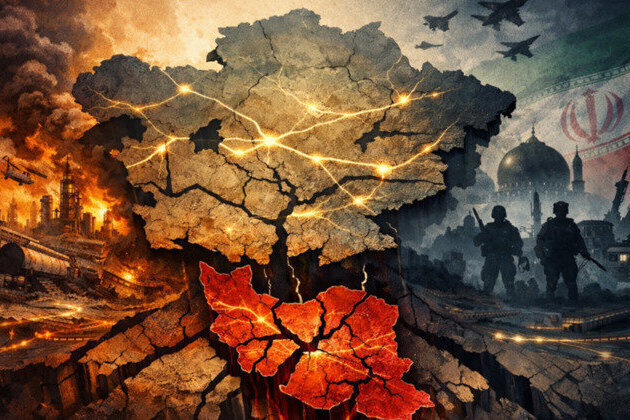
The war involving Iran has stirred mixed and uneasy reactions across Central Asia. The region, which has long seen itself as an island of relative stability between competing great powers, now faces a dilemma: both an Iranian collapse and an Iranian victory carry risks.
Since gaining independence, the countries of Central Asia (broadly know in the West as 'The Stans') haven't operated in what might be called a hostile geopolitical environment. Their larger neighbors, Russia to the north, China to the east, and Iran to the south-west, have effectively formed a buffer, allowing these states to pursue development without direct exposure to the kinds of pressures faced by countries bordering Turkey and Israel. Or, indeed, the United States.
The only persistent source of instability has been Afghanistan. From the late 1970s until 2021, it was a constant theatre of war. Yet even there, the situation has stabilized in recent years, following the US withdrawal and the Taliban's return to power. For all the uncertainties, Afghanistan today poses less of an immediate risk of large-scale regional destabilization than it once did.
The conflict now unfolding around Iran is different. It threatens to upset the delicate balance that has allowed Central Asia to thrive.
Initially, the greatest concern in the region was the possibility of Iran's fragmentation, a scenario long discussed in strategic circles and viewed by some in Israel and the United States as desirable. A disintegrating Iran, plunged into civil strife, would almost certainly become a source of instability, exporting security threats northwards into Central Asia.
Even more troubling would be the geopolitical consequences. A weakened or fragmented Iran could provide Washington with a new foothold in the region. The United States has long pursued a strategy of exerting pressure on its principal adversaries, Russia and China, by influencing developments in neighboring states. This hasn't necessarily been done through direct confrontation, but by the creation of zones of instability that force its rivals to divert attention and resources.
Since the Taliban's return to power, Washington's options in Afghanistan have narrowed. But chaos in Iran could reopen possibilities. For Central Asian governments, which have ambitious development plans and value their relative calm, this would be a deeply unwelcome development.
The region has, in fact, benefited from its geopolitical position. Acting as a hub for trade, transit and financial flows, Central Asia has gained economically in recent years, particularly since the onset of the conflict between Russia and the West over Ukraine. Russian investment has increased, and trade routes have diversified.
An Iranian collapse would threaten this fragile prosperity. Already, the conflict in the Middle East has disrupted established trade patterns. The Gulf states and Iran itself have become less reliable partners in the long term. A broader regional war would only accelerate this shift.
However, a collapse of Iranian statehood did not occur. A month after the start of the war, Tehran is demonstrating a very high degree of resilience to the pressure being exerted on it. It is even shifting to tactical counteroffensives, testing the strength of US allies in the region. It appears that Tehran has a fair chance of emerging from this confrontation not as a victor, but as a battered yet worthy opponent of the United States.
But this is hardly reassuring.
A resilient Iran, having withstood pressure from the United States and Israel, could adopt a more assertive regional posture. For Central Asian states, this would likely mean a renewed need to align more closely with the preferences of Moscow and Beijing. Such an outcome would sit uneasily with the "multi-vector" foreign policies that have allowed these countries to balance between competing powers.
In this sense, Central Asia has found itself in a genuinely ambivalent position. Instability in Iran poses obvious risks. But stability, if it comes in the form of a strengthened Iranian state, may also constrain the region's strategic flexibility.
The broader regional picture adds further complexity. Continued conflict risks turning the Middle East into a permanently unstable zone, raising the specter of nuclear proliferation and undermining the long-term viability of key economic partners in the Persian Gulf. These states have served not only as sources of investment but also as safe havens for capital and venues for discreet diplomatic engagement.
Transport and trade are also at stake. Plans to develop alternative corridors across the Caspian Sea, bypassing Russia, could be derailed by wider instability. These routes have only recently begun to function reliably. A deterioration in the regional security environment would threaten both their economic viability and their political rationale. All the more so if, in a couple of years, diplomats manage to achieve some easing of tensions in Eastern Europe: in that case, China will very quickly return to using transit routes through Russia.
At the same time, unexpected opportunities may emerge. Afghanistan, long seen as a source of instability, could find itself in a more advantageous position.
For several years, there has been discussion of a Trans-Afghan transport corridor linking Russia, Central Asia and Pakistan's ports on the Indian Ocean. The project has attracted broad interest, including from Moscow. While progress has been slow and current tensions between Afghanistan and Pakistan offer little cause for optimism, a prolonged crisis in the Middle East could alter the strategic landscape.
If instability drives trade routes away from traditional corridors, Afghanistan could, for the first time in centuries, become integrated into major international commerce. For Central Asia, this would be a significant development, potentially enhancing regional prosperity while reducing opportunities for external powers to reassert influence along the southern borders of the former Soviet space.
Ultimately, the war around Iran presents Central Asia with a paradox. It increases the likelihood of both serious disruption and new opportunity. Much will depend on how the region's leaders navigate this uncertain environment.
Over the past three decades, the countries of Central Asia have shown a capacity for cautious, pragmatic decision-making. That record offers some grounds for optimism.
This article was first published byVzglyadnewspaper and translated and edited by the RT team.
(RT.com)



 Share
Share
 Tweet
Tweet
 Share
Share
 Flip
Flip
 Email
Email