An editorial in Japan's Mainichi Shimbun pointed out that Takaichi lacks the broader vision needed to maintain regional stability, and that her "exclusionary diplomacy" is unlikely to gain wider acceptance.
TOKYO, May 30 (Xinhua) -- Japanese Prime Minister Sanae Takaichi and visiting Philippine President Ferdinand Romualdez Marcos held a summit meeting here on Thursday.
The two sides agreed to begin formal negotiations to conclude a security intelligence-sharing agreement and decided to upgrade bilateral relations to a comprehensive strategic partnership.
Analysts said Japan has been deepening security collusion with the Philippines, while doubling down on exclusionary "small-circle" diplomacy.
Behind these moves lies not only Japan's drive to strengthen its military influence in the Asia-Pacific region but also a broader agenda to break free from postwar constraints and pursue military and arms industry buildup, casting a long shadow over regional peace and security.
COLLUDING WITH THE PHILIPPINES
Defense and security cooperation was a key focus of the meeting between the Japanese and Philippine leaders.
The two sides agreed to commence formal negotiations on the General Security of Military Information Agreement, aiming to establish a framework for defense intelligence exchange and cooperation.
Analysts said Tokyo is seeking to leverage the pact to build a trilateral U.S.-Japan-Philippines intelligence-sharing mechanism, given that Washington has already signed a similar agreement with Manila.
The two countries also agreed to accelerate discussions between the defense authorities to advance the transfer of Japan's Abukuma-class destroyers and TC-90 trainer aircraft to the Philippines.
Though no longer in their prime, Abukuma-class destroyers still retain patrol, reconnaissance, and certain combat capabilities.
Japan also pledged to continue supporting the Philippine Coast Guard's capacity building through the provision of patrol vessels and joint training.
Notably, the two countries elevated their current strategic partnership to a "comprehensive strategic partnership," the second-highest level of bilateral ties for Japan after an alliance.
In recent years, Japan and the Philippines have been ramping up security collaboration, with their relationship trending toward a "quasi-alliance."
During this year's U.S.-Philippines "Balikatan" joint military exercises, Japan for the first time sent a large contingent of combat personnel to the drills and fired Type 88 surface-to-ship missiles on Philippine soil.
Analysts see this as Japan leveraging the Philippines to shake off the constraints of the postwar order and expand the Self-Defense Forces' operational reach abroad.
Beyond direct military cooperation, Japan has also been tightening its strategic grip on the Philippines through aid mechanisms. For three consecutive years, Tokyo has provided Manila with free defense equipment through its official security assistance framework, with further aid expected in fiscal 2026.
Commentators said that Japan is seeking to use security assistance to extend its influence over the Philippines while opening up overseas markets for its domestic defense industry. For Japan, the Philippines is not just a key defense partner but also a major arms customer.
Chen Yang, a visiting research fellow at Liaoning University's Institute of Japan Studies, said that Japan's drive to strengthen ties with the Philippines and expand arms exports serves a dual purpose: normalizing weapons exports for economic gain, while also colluding with Manila to stir up regional insecurity and jointly craft a so-called "external threats" narrative, creating the conditions needed to justify the Takaichi cabinet's military buildup and its relentless push to revise the pacifist Constitution.
SMALL-CIRCLE DIPLOMACY DOOMED TO FAIL
Japan has been on a diplomatic blitz lately, and hosting the Philippine president is just part of it. Takaichi herself has visited Vietnam, Australia, and South Korea in succession, while multiple Japanese cabinet members have fanned out to Southeast Asia, Europe, and Africa.
Magosaki Ukeru, a former Japanese foreign ministry official, said Takaichi's recent flurry of diplomatic activities is essentially clique building, but regional countries have no appetite for picking sides, and Takaichi has little tangible diplomatic progress to show for it.
In Australia, Takaichi sought to tighten security ties through defense cooperation. Japan has actively pushed for the export of upgraded Mogami-class frigates to Australia, deepening coordination on defense industry and security policy.
In South Korea, Takaichi pursued mutual swap transactions for crude oil, petroleum products, and liquefied natural gas between the two countries, attempting to draw Seoul further into Japan's regional agenda through energy cooperation.
In Vietnam, Takaichi touted cooperation with relevant countries across energy, critical minerals, semiconductors, artificial intelligence, and defense equipment.
Analysts said the Takaichi government is trying to weave together trade, energy, and supply chain issues with defense and security planning, drawing in so-called "like-minded countries," all with the underlying goal of using economic security as a smokescreen to lower regional countries' guard against expanding security cooperation with Japan.
Japan's Jiji Press, citing sources within the ruling Liberal Democratic Party (LDP), reported that Takaichi's repeated emphasis on promoting the "Indo-Pacific" concept put forward by former Prime Minister Shinzo Abe also reflects a political calculation to shore up support among domestic conservatives.
THREAT TO REGION, TRAP FOR JAPAN
At the same time, Japan has continued to loosen its security policies at home, hiking defense spending and lifting the ban on lethal weapons exports, to name just a few.
In addition, the LDP has recently drafted proposals for revising Japan's three key security documents within this year, calling for stronger air defense systems and enhanced long-term combat capabilities, early deployment of interceptor drones and high-energy weapons, and accelerated research into next-generation submarines designed to carry long-range missiles.
Lu Hao, an expert at the Institute of Japanese Studies of the Chinese Academy of Social Sciences, said the moves toward military expansion and loosening defense restrictions would not only benefit Japan's military-industrial complex but also extend the country's military influence beyond its borders, giving it the muscle to meddle in regional affairs.
He warned that the developments could deepen Japan's strategic entanglement with certain regional and non-regional countries, fueling security anxieties across the region and raising the risk of an arms race.
Analysts said Takaichi's simultaneous pursuit of "small circle" diplomacy and military buildup is sowing the seeds of instability in the region.
Satoshi Tomisaka, a professor at Japan's Takushoku University, said Japan's current diplomatic posture reflects a clear bloc confrontation mindset, but such binary thinking is not what the world needs today.
An editorial in Japan's Mainichi Shimbun pointed out that Takaichi lacks the broader vision needed to maintain regional stability, and that her "exclusionary diplomacy" is unlikely to gain wider acceptance.
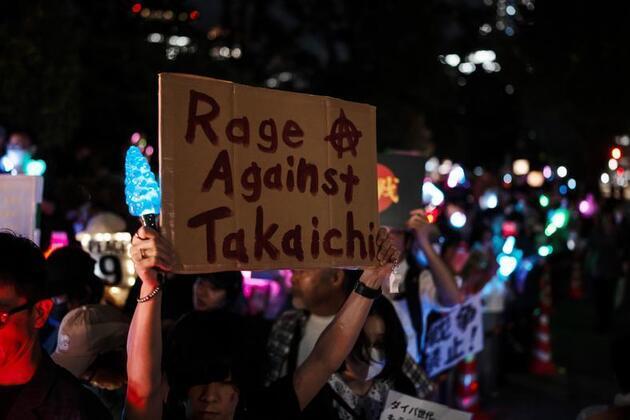
The Takaichi administration's foreign and security policies have also drawn criticism at home for exacerbating social and economic burdens.
Shigeaki Koga, a former official at Japan's Ministry of Economy, Trade and Industry, said the Takaichi administration has invoked the so-called "most severe and complex security environment of the postwar era" to justify relentless defense spending hikes.
Against a backdrop of soaring government debt and mounting social security burdens, he warned that runaway military spending risks crowding out funding for public welfare areas such as education and healthcare, and could push Japan into fiscal imbalance and economic stagnation, ultimately undermining the country's long-term development.



 Share
Share
 Tweet
Tweet
 Share
Share
 Flip
Flip
 Email
Email